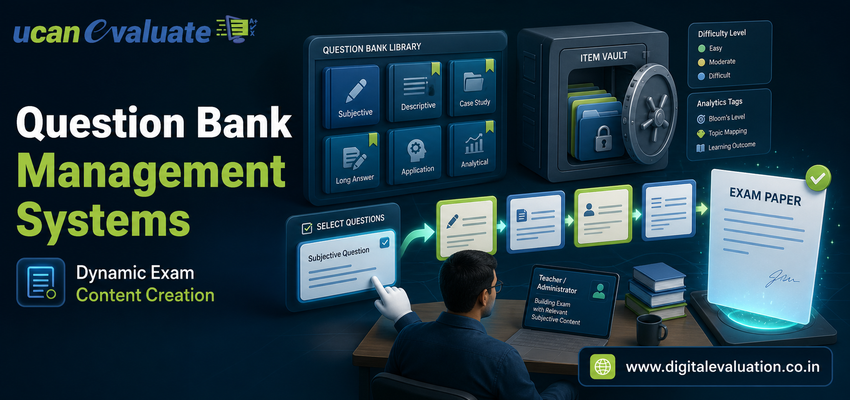
What if your university could prepare multiple question papers without starting from scratch every semester—while maintaining academic quality, examination security, and syllabus coverage?
For many universities and examination boards, question paper creation is still a demanding process. Faculty members prepare questions, academic committees review them, and examination departments coordinate approvals, formatting, and confidential distribution.
When these activities depend on spreadsheets, scattered documents, and repeated email exchanges, even a small change in an examination paper can create unnecessary complications.
A modern Question Bank Management System offers a more structured approach.
By combining centralized question repositories, intelligent categorization, academic blueprints, controlled approvals, and automated paper generation, institutions can transform examination content creation into a more efficient and manageable process.
At Learning Spiral Ltd., we help universities and examination authorities modernize question preparation and connect it with a broader digital examination ecosystem.
Let’s explore eight practical steps to building secure, dynamic, and academically balanced examination papers.
What Is a Question Bank Management System?
A Question Bank Management System is a digital platform that allows educational institutions to create, store, categorize, review, and reuse examination questions through a centralized repository.
The underlying concept of a question bank is straightforward: maintain a structured collection of assessment questions along with the information needed to use them appropriately.
A modern system goes further by supporting academic classifications, question paper blueprints, approval workflows, controlled user access, and dynamic question selection.
Instead of manually assembling every examination paper, authorized teams can select approved questions based on course requirements, difficulty levels, marks distribution, and predefined academic rules.
This makes Question Bank Management particularly useful for universities handling multiple departments, academic programmes, semesters, and examination cycles.
The objective is not simply to create papers faster. It is to build a repeatable and accountable process that supports examination quality.
Step 1: Start with a Clear Examination Blueprint
The first step in dynamic exam content creation is determining what an examination should assess.
Before selecting questions, examination committees need to define the syllabus coverage, learning objectives, question formats, marks distribution, and expected difficulty levels.
Consider a university preparing a 60-mark examination.
Its approved blueprint might contain 10 one-mark objective questions, five four-mark short-answer questions, and three ten-mark descriptive questions.
Together, these sections produce a 60-mark paper.
However, simply meeting the required total is not enough.
The examination must also reflect the prescribed syllabus and an appropriate balance of knowledge, application, and analytical skills.
A Question Bank Management System can help administrators configure these rules before generating a paper.
The result is a structured starting point for creating different versions of the examination while preserving the approved pattern.
Step 2: Build a Centralized Repository of Approved Questions
Imagine an institution managing hundreds of courses across engineering, commerce, science, humanities, and management.
Every semester, departments develop and review numerous questions. Without centralized storage, valuable academic content may become difficult to locate, verify, or reuse.
A digital question repository addresses this challenge by organizing examination questions within a controlled environment.
Questions can be grouped according to programme, subject, course, semester, unit, topic, academic session, and approval status.
Institutions can maintain multiple formats, including objective questions, short-answer questions, long-form descriptive questions, case studies, and diagram-based assessments.
This is particularly valuable when examination authorities need to prepare different papers for regular examinations, supplementary assessments, or multiple examination sessions.
Instead of repeatedly requesting previously approved content, authorized academic teams can retrieve suitable questions from the repository.
Over time, the repository becomes a valuable institutional resource, supporting greater consistency in question paper preparation.
Step 3: Use Smart Tagging to Improve Question Selection
A question bank becomes more useful when its content is organized intelligently.
Consider two questions from the same subject. One tests basic factual knowledge, while the other requires students to analyze a complex situation.
Although both belong to the same syllabus unit, they serve different assessment purposes.
This is where question tagging becomes important.
Modern Question Bank Management solutions can organize questions using attributes such as topic, difficulty level, question type, learning outcome, marks, language, and previous usage.
AI-assisted categorization can also support the identification and organization of questions within large repositories.
For example, an examination committee preparing an analytical mathematics paper could prioritize approved questions tagged for problem-solving and higher-order thinking rather than selecting questions randomly.
However, intelligent classification must be supported by academic validation.
Faculty members and subject experts should review question accuracy, relevance, complexity, and alignment with intended learning outcomes.
Technology can accelerate question discovery, but academic experts must remain responsible for examination quality.
Step 4: Introduce Structured Review and Approval Workflows
Question creation is only one part of examination preparation.
Every question should pass through an appropriate verification process before becoming eligible for final paper generation.
A structured approval workflow can help institutions assign responsibilities to question setters, reviewers, moderators, and examination administrators.
For example, a subject expert may prepare a question, a second reviewer may verify academic correctness, and an authorized moderator may approve its use.
Questions requiring corrections can be returned for revision instead of being included prematurely in an examination.
Version histories and approval records also help institutions understand which content was revised, who approved it, and which version was finalized.
This is especially important for universities conducting high-stakes examinations where ambiguous wording or incorrect answers can create student grievances.
Learning Spiral Ltd.’s examination technology approach emphasizes structured digital workflows that bring greater control and accountability to academic operations.
The goal is to make review and approval a defined part of the process rather than a last-minute administrative activity.
Step 5: Generate Dynamic Question Papers Without Losing Academic Balance
Once institutions have approved questions and a defined examination blueprint, they can begin creating dynamic papers.
Dynamic generation does not mean choosing questions without academic controls.
It means selecting suitable questions from an approved repository according to predefined rules.
For instance, a university might require every examination version to include specified coverage of four syllabus units, a prescribed mix of question types, and a balanced difficulty distribution.
A properly configured Question Bank Management System can support the creation of different paper combinations that follow these requirements.
Question exposure and previous usage history can also help examination teams reduce unnecessary repetition.
This approach is useful for institutions managing multiple examination shifts, supplementary examinations, and different assessment groups.
However, different question papers are not automatically equivalent in difficulty.
Authorized academic reviewers should examine every final version to confirm that its scope, marks distribution, clarity, and level of challenge remain appropriate.
A dynamic question generation process should therefore combine rule-based automation with academic moderation.
The benefit is flexibility without abandoning assessment standards.
Step 6: Protect Confidentiality Throughout Question Paper Creation
Question paper confidentiality is one of the most important responsibilities of an examination authority.
A single unauthorized disclosure can disrupt examination schedules, affect student confidence, and create major administrative challenges.
Security must therefore begin long before an examination paper reaches students.
A modern University Examination System should apply appropriate access controls to question creation, review, approval, finalization, and distribution.
Sensitive content should only be available to authorized personnel according to their responsibilities.
Useful security measures include controlled user permissions, secure authentication, encryption, activity logging, and restrictions on confidential document access.
Institutions should also establish procedures for approving final papers, securely handling revisions, and releasing examination content at the appropriate time.
Learning Spiral Ltd.’s secure question paper workflows, including UCanSecure, support controlled paper creation and distribution as part of examination management.
Security technology must work alongside institutional policies, staff training, and clear accountability.
This helps universities reduce avoidable confidentiality risks and build stronger examination governance.
Step 7: Connect Question Creation with Examination Delivery
Creating a secure question paper is not the end of the examination process.
The approved content must reach the correct examination environment, in the prescribed format, at the required time.
This is where integration becomes important.
During Pre Examination Processing, universities may manage course mappings, examination schedules, candidate eligibility, question paper preparation, and other administrative activities.
Question Bank Management can support this phase by helping institutions organize and finalize academic assessment content.
For computer-based examinations, an Online Examination System can deliver approved questions electronically and capture candidate responses.
For traditional pen-and-paper examinations, authorized teams may use controlled question paper preparation and secure distribution processes.
The ideal approach depends on examination regulations, institutional requirements, candidate accessibility, and the delivery model.
A connected University Examination System enables institutions to coordinate these processes more effectively instead of maintaining disconnected applications.
It also helps examination administrators maintain clearer oversight of examination preparation and delivery.
Step 8: Connect Question Banks with Digital Evaluation and Result Processing
A successful examination workflow should not end when students submit their responses.
After examination delivery, institutions must manage answer scripts, evaluation, moderation, marks verification, and result publication.
This creates an important connection between Question Bank Management and Digital Evaluation.
For handwritten examinations, Answer Booklet Scanning converts physical scripts into digital images that can be securely processed and allocated to evaluators.
An On Screen Evaluation System then enables authorized evaluators to review digitized responses without physically transferring answer booklets between locations.
Through On-Screen Marking, examiners can enter marks, review responses, and use available annotation and moderation tools within the evaluation platform.
A properly integrated Digital Evaluation System can connect approved marking schemes, maximum marks, question references, and evaluation records.
This is where the benefits of well-structured question data become particularly valuable.
When question papers are clearly defined, approved, and properly mapped, evaluation departments have a stronger foundation for applying consistent marking rules.
Following evaluation and moderation, Post Examination Processing supports activities such as marks compilation, verification, result preparation, and publication.
The complete examination journey becomes more coordinated:
Question Bank Management → Examination Preparation → Examination Delivery → On-Screen Evaluation → Post Examination Processing → Results
For universities, this connected approach can reduce repetitive administrative work and improve visibility across examination operations.
A Practical Example: Preparing Three Versions of a 60-Mark Examination
Consider a hypothetical university preparing three versions of a semester examination.
The academic committee approves a 60-mark blueprint, defines the syllabus units to be covered, and specifies the marks distribution for objective, short-answer, and descriptive questions.
Faculty members contribute questions to a centralized repository.
Each question receives appropriate academic tags and passes through a review and moderation process.
The examination department then applies rules for syllabus coverage, question formats, difficulty distribution, and previous question usage.
Using an approved pool of questions, the institution prepares three different examination versions.
Before finalization, authorized academic experts review all versions for accuracy, clarity, appropriate difficulty, and comparable academic expectations.
The finalized papers enter a controlled distribution workflow.
After the examinations, responses proceed through the appropriate Digital Evaluation or marking process.
This example demonstrates how dynamic question paper creation can support flexibility while maintaining human oversight.
The advantage is not simply producing three papers. It is following a reliable academic process that can be repeated across examination cycles.
How Learning Spiral Ltd. Supports Smarter Examination Management
At Learning Spiral Ltd., our focus is on helping universities, educational institutions, and examination bodies improve the way they prepare, conduct, evaluate, and manage examinations.
Our Question Bank Management capabilities support structured question repositories, intelligent categorization, academic content management, and more efficient question paper preparation.
We recognize that universities need more than an isolated question creation tool.
Examination departments also require coordination between content preparation, secure delivery, assessment, evaluation, and result processing.
Learning Spiral’s examination technology ecosystem supports institutions through solutions and services covering Question Bank Management, Online Exam Solution, Online Assessment, On-Screen Evaluation, On Screen Marking System, and Digital Evaluation.
Our approach helps institutions establish connected workflows while retaining the academic review and operational controls required for university examinations.
Whether your institution is transitioning from manual question preparation or modernizing an existing University Management System, Learning Spiral can help assess the appropriate digital workflows, integration requirements, and implementation approach.
What Should Universities Check Before Choosing a Question Bank Management System?
Choosing the right platform requires more than comparing the number of available features.
Universities should evaluate whether the system supports their academic regulations, examination patterns, security expectations, and future expansion plans.
It is important to understand how questions are created and reviewed, how examination blueprints are configured, and how previously used questions are tracked.
The institution should also examine user permissions, confidentiality controls, version management, multilingual requirements, and system integration capabilities.
Equally important is the platform’s ability to support faculty members and examination administrators without introducing unnecessary complexity.
A suitable solution should help the university maintain academic control while simplifying repetitive examination tasks.
The best implementation is one that aligns technology with the institution’s existing governance and examination requirements.
Frequently Asked Questions
1. What is the main purpose of Question Bank Management?
Question Bank Management helps institutions create, organize, review, store, and reuse examination questions through a structured digital repository. It supports efficient question paper preparation while improving control over academic content.
2. Can a Question Bank Management System create different versions of an examination?
Yes. A properly configured system can support the selection of different approved question combinations according to predefined blueprints, syllabus coverage, marks distribution, and difficulty requirements. Final versions should still undergo academic review.
3. Does Question Bank Management support subjective examinations?
Yes. Question banks can accommodate objective, descriptive, case-based, and other suitable question formats. The supported formats and authoring features depend on the specific platform and configuration.
4. How is Question Bank Management different from Online Assessment?
Question Bank Management focuses on preparing and organizing examination content. Online Assessment refers more broadly to using digital technologies for conducting or managing assessment activities. The two can work together within a connected examination ecosystem.
5. Can Question Bank Management be integrated with Digital Evaluation?
Yes. When suitable integrations are available, question references, marks distribution, and marking schemes can support downstream evaluation workflows. Institutions should confirm the integration requirements and supported capabilities before implementation.
6. How does Question Bank Management improve examination security?
It can support role-based access, controlled review processes, secure storage, version tracking, and auditable question paper preparation. Security effectiveness also depends on institutional policies, system configuration, and operational practices.
Conclusion: Build Better Exams Before They Begin
Examination excellence does not start with evaluating answer scripts. It begins with creating appropriate, secure, and academically meaningful questions.
A modern Question Bank Management System helps educational institutions move from repetitive manual paper-setting processes toward more structured, flexible, and controlled examination content creation.
By combining centralized question repositories, academic tagging, approval workflows, dynamic paper selection, and integration with Digital Evaluation, universities can build a stronger foundation for the complete examination lifecycle.
Learning Spiral Ltd. helps institutions move toward this connected approach with examination technology solutions designed around real academic and administrative needs.