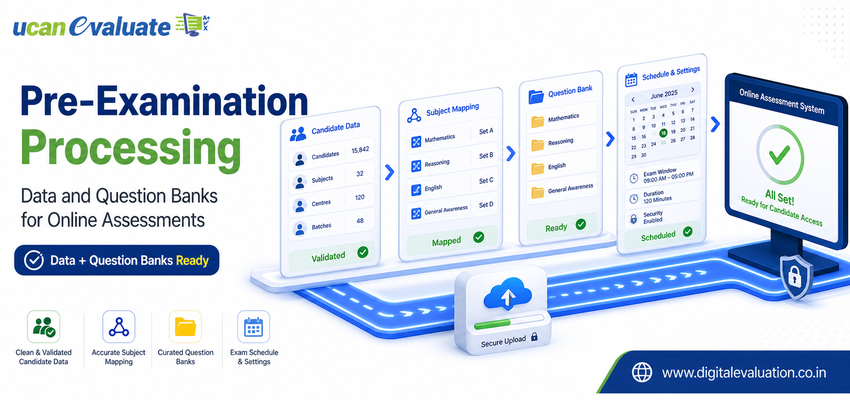
Pre Examination Processing: 9 Essential Steps for Secure Online Assessments
What if the success of your next university examination was decided weeks before the first student logged in?
Imagine a university preparing to conduct online examinations for thousands of students. The examination platform is ready, faculty members have submitted their questions, and the schedule has been announced.
But when the examination begins, a few unexpected challenges emerge. Some candidates have incorrect subject mappings, a question paper contains an outdated syllabus reference, and a last-minute change has not reached every examination centre.
These problems may look like exam-day issues, but their origins often lie much earlier.
This is why Pre Examination Processing is essential to a well-managed assessment lifecycle.
From validating candidate records and managing question banks to securing question papers and preparing examination schedules, every pre-examination activity contributes to the reliability of the final assessment.
For universities, examination boards and higher education institutions, effective preparation is not simply administrative work. It is the foundation of secure Online Assessment, accurate Examination Processing and a dependable University Examination System.
What Is Pre Examination Processing?
Pre Examination Processing refers to the academic, administrative and technical activities completed before an examination is conducted.
It involves preparing candidate information, validating examination eligibility, mapping subjects, developing question papers, scheduling assessments, assigning responsibilities and verifying system readiness.
The objective is straightforward: ensure that candidates, questions, examination rules and technology are correctly aligned before the examination begins.
In the broader context of Online Assessment, these activities help institutions create an organised environment for delivering examinations electronically.
A particularly important component is Question Bank Management, which helps institutions maintain structured repositories of assessment questions and the information associated with them.
When these activities are managed systematically, examination teams can reduce unnecessary manual coordination, identify discrepancies earlier and improve their readiness for examination day.
9 Essential Pre Examination Processing Steps for Universities
1. Build Accurate and Verified Candidate Data
Every successful examination begins with trustworthy candidate information.
Universities typically maintain extensive records covering student identities, registration numbers, programmes, semesters, subject combinations, examination eligibility and academic history.
Even a small mismatch can create confusion during admit card generation, attendance preparation or examination access.
A structured Pre Examination Processing workflow should therefore include candidate-data verification, duplicate identification, eligibility checks and subject-mapping validation.
For example, a student appearing for a supplementary examination may require a different subject mapping from a regular-semester candidate.
Checking these conditions before scheduling helps prevent unnecessary complications.
Integration with an existing University Management System can also reduce repeated data entry and help examination departments maintain more consistent records.
2. Define the Examination Blueprint Before Creating Questions
A good assessment is not simply a collection of difficult questions. It must represent the syllabus, learning objectives and intended academic standards.
Before question creation begins, institutions should define a clear examination blueprint.
The blueprint can specify the subjects and units to be assessed, marks distribution, question formats, difficulty levels, learning outcomes and examination duration.
Consider a 100-mark examination covering five syllabus units. Without predefined rules, some units may receive excessive attention while others receive insufficient coverage.
A structured blueprint guides paper setters toward a more balanced and academically meaningful examination.
It also supports consistency across multiple papers, departments and assessment sessions.
This preparation is especially important for universities implementing outcome-based education and conducting examinations across large academic programmes.
3. Create a Centralized and Secure Question Bank
Scattered question papers, spreadsheets, email attachments and departmental folders can make examination-content management unnecessarily complicated.
A centralized question repository provides a more organised alternative.
Through Question Bank Management, institutions can create, store, classify, review and reuse approved examination questions.
Questions may be organised according to subject, syllabus unit, question type, difficulty level, marks allocation and learning outcomes.
A well-designed question bank can also support multiple formats, including MCQs, descriptive questions, numerical responses, case studies and image-based questions.
Rather than preparing every assessment from disconnected files, authorised faculty members can work within a structured academic repository.
The result is improved content organisation and greater control over the question-paper preparation process.
4. Introduce Academic Review, Moderation and Approval
Creating questions is only one part of preparing an examination.
Every question also needs to be reviewed for relevance, correctness, clarity and alignment with the prescribed syllabus.
A systematic review workflow allows academic experts to examine questions before they become part of an approved question bank.
For instance, a question may be grammatically correct but have two plausible answers. Another may refer to content removed during a syllabus revision.
Without proper moderation, these issues can reach students during the examination.
Pre Examination Processing should therefore define clear responsibilities for question authors, reviewers, moderators and final approving authorities.
Version control and approval records can provide greater visibility into how examination content was reviewed and finalised.
Strong academic oversight remains essential even when institutions use technology-assisted question creation.
5. Prepare Balanced Question Papers and Marking Schemes
Once the question bank is ready, universities must convert approved questions into examination-ready papers.
This involves selecting appropriate questions, confirming the total marks, maintaining difficulty balance and checking the structure of each examination section.
For online examinations, question-paper preparation may also include configurable question order, multiple paper sets, answer-option randomisation and different candidate versions.
However, randomisation should never compromise academic fairness.
Each version should meet the intended syllabus coverage, question distribution and difficulty requirements.
Equally important is the preparation of marking schemes.
Objective questions require correctly configured answers and scoring rules. Descriptive questions may require marking rubrics, question-wise maximum marks and evaluator instructions.
Well-prepared marking information can later support On Screen Marking and structured Digital Evaluation workflows.
6. Finalize Examination Schedules, Eligibility and Candidate Access
Universities often manage multiple programmes, semesters, examination centres and candidate groups within the same academic calendar.
An effective examination schedule must account for these complexities.
During Pre Examination Processing, administrators should validate examination dates, time slots, subject combinations, candidate eligibility and centre capacity.
Where applicable, the system should also support admit card generation, candidate notifications and controlled examination-access permissions.
For instance, a student registered for a specific paper should receive access only to the examination for which they are eligible.
Similarly, academic departments should have enough time to confirm timetable changes before schedules are finalised.
Centralised scheduling reduces the dependence on disconnected communications and provides a more consistent source of examination information.
7. Test the Online Examination System Before Going Live
An examination platform that works during a small demonstration may behave differently when thousands of candidates access it simultaneously.
That makes technical readiness a critical part of Pre Examination Processing.
Before deployment, institutions should assess the security, scalability and operational capabilities of their Online Examination System.
Important considerations include candidate authentication, expected concurrent users, examination navigation, response saving, session recovery and system monitoring.
Universities should also test how the platform handles interruptions such as connectivity loss, device failure and temporary service unavailability.
These tests help administrators understand potential risks and define appropriate response procedures.
A dependable Online Exam Solution should reflect the institution’s examination requirements rather than forcing every academic programme into the same configuration.
8. Conduct Mock Assessments and Prepare Support Teams
Even the most carefully configured system benefits from practical testing with real examination scenarios.
Mock assessments allow institutions to evaluate not only the technology but also the experience of candidates and administrators.
Students can become familiar with login procedures, examination navigation, answer submission and time limits.
Meanwhile, examination teams can test attendance monitoring, technical-support workflows and escalation procedures.
For remote or multi-centre examinations, mock assessments can help identify connectivity constraints and operational differences between locations.
Institutions should also review accessibility requirements, approved accommodations and clear candidate instructions.
Equally important is establishing a helpdesk process for reporting and resolving examination-related issues.
The purpose of a mock examination is not merely to demonstrate that the platform works. It is to establish confidence that the entire examination process is operationally ready.
9. Prepare Data for Evaluation and Post Examination Processing
A university examination does not end when students submit their responses.
The information generated before and during an examination must eventually support evaluation, marks consolidation, academic verification and result preparation.
This is why Pre Examination Processing should consider downstream requirements from the beginning.
For paper-based descriptive examinations, students’ handwritten scripts may undergo Answer booklet scanning or Scanning of Answer Sheets before entering an On-Screen Evaluation workflow.
Within an On Screen Evaluation System, authorised evaluators can assess digitised scripts without relying entirely on the physical movement of answer booklets.
An On Screen Marking System can support digital marks capture, evaluator allocation, annotations and moderation based on configured examination rules.
For digitally submitted responses, the process may move directly from assessment delivery into an appropriate evaluation workflow.
In either case, the institution should preserve correct candidate references, subject information, paper codes and marking rules.
This connection helps establish a more reliable foundation for Post Examination Processing.
Why Connected Examination Processing Matters
The true value of examination technology becomes clearer when different academic processes can work together.
Consider two institutions.
The first manages candidate records in one application, question papers in another, examination schedules through spreadsheets and evaluation data in a separate system.
The second follows a more connected approach in which authorised teams can exchange validated data across examination stages.
The second institution is better positioned to reduce repeated entry, improve administrative visibility and simplify coordination.
A modern University Examination System should therefore connect preparation, examination delivery, evaluation and result-related activities wherever appropriate.
A broader Digital Evaluation System can help institutions plan how scanning, evaluation, moderation and marks processing interact with examination master data.
This is especially valuable when a university conducts both traditional written examinations and computer-based assessments.
The objective is not to eliminate every existing academic process overnight. It is to create a dependable framework in which each process supports the next.
How Learning Spiral Ltd. Supports Modern Examination Management
Learning Spiral Ltd. helps universities, examination boards and educational institutions modernise examination-related processes through technology-driven solutions.
With more than 25 years of experience in education technology, Learning Spiral works across important stages of the examination lifecycle.
Its solutions address Pre Examination Processing, Question Bank Management, Online Assessment, Online Examination System requirements, Digital Evaluation, Answer Booklet Scanning, On-Screen Marking and Post Examination Processing.
The company’s examination technology ecosystem includes tools for question creation and management, assessment delivery, digital evaluation and related university examination workflows.
Learning Spiral’s Question Bank Management capabilities help institutions organise examination content, support academic review and prepare structured question papers.
Its connected examination solutions can also support the transition from assessment preparation to secure examination delivery and subsequent evaluation activities.
For institutions handling multiple examinations, programmes and candidate groups, this approach offers a practical path toward more coordinated examination administration.
Final Thoughts: Better Examinations Begin Before Exam Day
The quality of an examination is influenced long before students receive their questions.
Accurate candidate information, well-structured question banks, academic moderation, reliable schedules and tested digital infrastructure all contribute to examination readiness.
Pre Examination Processing brings these activities together within a more organised framework.
When institutions strengthen their pre-examination workflows, they create better conditions for secure Online Assessment, efficient On-Screen Evaluation and dependable Post Examination Processing.
The future of university examination management is not simply about moving examinations online.
It is about preparing every examination intelligently, conducting it securely and managing its outcomes with greater confidence.
Frequently Asked Questions
What is Pre Examination Processing in a university?
Pre Examination Processing includes preparing candidate records, validating eligibility, mapping subjects, managing question banks, generating examination schedules, configuring assessment rules and testing examination systems before examinations begin.
Why is Question Bank Management important for Online Assessment?
Question Bank Management helps universities organise, classify, review and approve examination questions. It supports the preparation of balanced question papers while maintaining better control over academic content and examination confidentiality.
How does Pre Examination Processing improve examination security?
It helps institutions control access to question papers, establish approval workflows, validate candidate eligibility, configure examination permissions and identify technical or operational risks before examination day.
Can online examinations and On-Screen Marking work together?
Yes. An institution can use an Online Examination System to conduct assessments and connect suitable responses with digital marking workflows. Paper-based examinations can also enter a Digital Evaluation process after answer booklet scanning.
How does Learning Spiral Ltd. support examination digital transformation?
Learning Spiral Ltd. provides examination technology solutions covering Question Bank Management, pre-examination activities, Online Assessment, Digital Evaluation, On Screen Marking and post-examination workflows for universities and examination bodies.