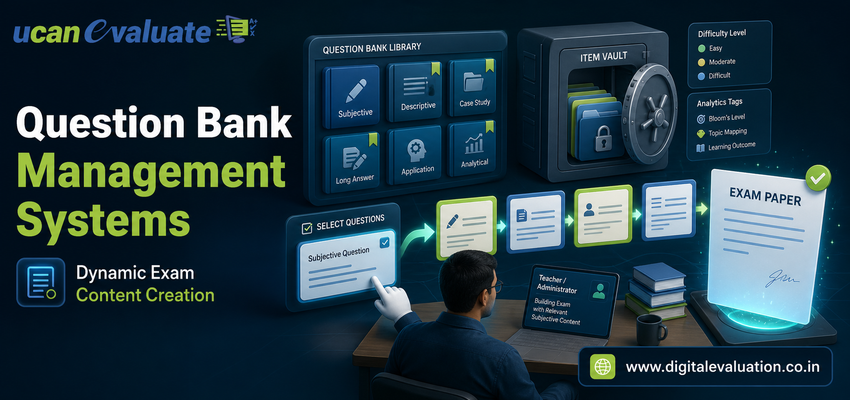
What if universities could create multiple balanced examination papers without rebuilding the entire question paper from scratch every semester?
For many universities and examination boards, question paper preparation remains one of the most time-consuming and confidential responsibilities in the examination lifecycle.
Faculty members develop questions, academic committees review them, examination departments coordinate approvals, and administrators manage final paper preparation. When these activities depend on scattered documents, spreadsheets and repeated email exchanges, even a small revision can create unnecessary complications.
Now imagine an examination ecosystem where questions are centrally organized, tagged according to academic requirements, reviewed through structured workflows and selected intelligently to create balanced question papers.
This is the value of a modern Question Bank Management System.
As universities embrace digital transformation, intelligent Question Bank Management is emerging as a critical foundation for reliable, flexible and scalable examination administration.
What Is a Question Bank Management System?
A Question Bank Management System is a digital platform that helps educational institutions create, store, categorize, review, retrieve and manage examination questions through a centralized repository.
Instead of preparing examination papers from disconnected files, institutions can use a structured database containing questions organized by academic parameters.
In assessment terminology, a question bank is a collection of examination items maintained for use across different tests and assessment formats.
An advanced system goes beyond storing questions. It helps institutions develop controlled question paper creation workflows while maintaining academic quality, confidentiality and consistency.
Learning Spiral Ltd. offers Question Bank Management capabilities designed to support universities, examination boards and other assessment organizations with structured question creation, intelligent categorization and secure examination processes.
Let’s explore seven ways these systems can transform how institutions prepare and manage examinations.
1. Create a Centralized Repository for Every Examination Question
Imagine a university managing hundreds of courses across different departments, academic programs and semesters.
Every examination cycle requires numerous questions covering different units, topics, learning outcomes and difficulty levels.
Without a centralized system, locating an appropriate question or verifying whether it was previously used can become difficult.
A modern Question Bank Management System brings examination content into one structured environment.
Questions can be classified according to their subject, course, semester, academic unit, learning outcome, question format, difficulty level and approval status.
For instance, a university conducting engineering examinations could maintain distinct question collections for programming, mathematics, electronics and mechanical engineering.
Within each collection, administrators can identify questions suitable for specific examination requirements without manually searching through numerous documents.
The advantage is not simply faster retrieval. It is better control over the university’s academic assessment content.
A centralized repository also helps preserve approved questions as reusable institutional resources.
2. Generate Dynamic Question Papers Using Academic Blueprints
One of the biggest challenges in examination preparation is ensuring that different question papers maintain comparable academic standards.
A question paper should not merely contain the required number of questions. It should reflect the intended syllabus coverage, marks distribution, learning objectives and complexity.
Dynamic question paper generation helps institutions address this challenge.
Within a structured University Examination System, administrators can define an examination blueprint based on institutional requirements.
Consider a university preparing a 60-mark examination.
The examination committee might specify that 20% of the marks should assess foundational knowledge, 50% should assess application-based learning, and 30% should assess analytical understanding.
A properly configured question bank can help select suitable questions according to these predefined criteria.
Institutions can also generate multiple paper versions using approved question combinations while applying controls over repetition, difficulty and topic coverage.
This creates an opportunity to build different examination papers without compromising the prescribed academic structure.
However, question paper equivalence should still be reviewed by authorized academic experts. Automated selection supports the process; it does not replace academic judgment.
The result is a more systematic approach to dynamic exam content creation.
3. Use AI-Assisted Question Selection Without Compromising Academic Quality
Artificial intelligence is introducing new possibilities for examination content management.
Rather than requiring administrators to manually inspect every question during paper preparation, AI-assisted systems can support activities such as question categorization, content discovery and selection according to configured criteria.
For example, intelligent tools may help identify questions associated with particular syllabus topics, difficulty levels or assessment objectives.
They can also support the organization of large repositories containing questions contributed by multiple departments.
Learning Spiral’s Question Bank Management capabilities include AI-powered question selection and automated tagging to help institutions prepare balanced assessments.
However, AI-generated or AI-selected content must still pass through appropriate academic review.
Subject experts should verify that each question is accurate, unambiguous, relevant to the syllabus, appropriate for the intended difficulty level and free from avoidable bias.
This human oversight is especially important for high-stakes university examinations.
The objective should be to use AI to reduce repetitive administrative work while allowing educators to focus on academic quality.
Smart examination automation is most effective when intelligent technology and faculty expertise work together.
4. Strengthen Question Paper Confidentiality and Approval Control
Question paper confidentiality is one of the most sensitive responsibilities of an examination department.
An unauthorized disclosure, accidental document sharing or incorrect version can disrupt an entire examination schedule.
Traditional workflows frequently involve multiple transfers of sensitive content between question setters, moderators and administrators.
Each unnecessary transfer introduces an additional point requiring security controls.
A secure Question Bank Management System can help reduce these risks by creating more controlled access and approval workflows.
Institutions should look for role-based permissions, authentication, restricted editing rights, version histories, audit trails and secure storage mechanisms.
For example, question setters may be authorized to create and submit questions, while moderators review academic suitability and designated examination officials approve final selections.
Such segregation of responsibilities can help institutions maintain accountability across the question paper creation process.
When combined with secure question paper distribution procedures, these controls can strengthen the overall confidentiality framework.
No technology can guarantee that examination materials will never be compromised, but carefully implemented access controls and operational safeguards can significantly improve risk management.
Question paper security should be built into the workflow rather than treated as a final administrative task.
5. Support Multiple Question Formats and Better Assessment Design
Modern examinations are becoming increasingly diverse.
Universities are no longer limited to traditional short-answer and long-answer questions.
Depending on the subject and examination format, assessments may contain multiple-choice questions, descriptive responses, case-based questions, diagrams, images, numerical problems, paragraph-based questions and multimedia content.
Managing these variations within separate documents makes question paper preparation more complicated.
An advanced Question Bank Management System allows institutions to organize multiple question formats within a structured repository.
For example, a medical institution may require image-based questions to assess diagnostic interpretation.
An engineering department may need numerical problems and technical diagrams.
A management institute may prefer analytical case studies that assess decision-making.
Learning Spiral’s UCanAssess question bank capabilities support different question formats, including objective, subjective, case-based and diagram-based items.
This flexibility allows academic teams to design assessments that more closely reflect the requirements of different courses.
It also supports a move away from purely memory-based testing toward examinations that evaluate comprehension, application and analytical thinking.
Better question diversity can help institutions measure learning more meaningfully.
6. Connect Question Bank Management With Pre Examination Processing and Online Assessment
Question paper preparation is only one component of a university’s examination lifecycle.
Before examinations begin, institutions must manage student eligibility, subject mapping, examination schedules, registration information, question paper approvals and other administrative activities.
These tasks form part of Pre Examination Processing.
When Question Bank Management operates separately from these workflows, examination departments may need to transfer information manually between multiple systems.
A connected University Examination System can reduce unnecessary coordination by maintaining structured relationships between academic records, approved questions and examination requirements.
For institutions conducting computer-based assessments, a secure Online Examination System can support digital examination delivery and related administration.
Question banks can provide approved examination content for appropriate online testing workflows.
More broadly, Online Assessment uses information technology to support different forms of assessment, including computer-based testing and digitally managed examinations.
A university may use online examinations for entrance assessments while continuing to conduct handwritten descriptive semester examinations.
A flexible examination ecosystem should accommodate these different operating models.
With the right integrations, Question Bank Management, Online Exam Solution, Pre Examination Processing and examination delivery can work together rather than operate as isolated activities.
The goal is to create a connected examination experience from academic planning to assessment delivery.
7. Build a Connected Workflow From Question Creation to Digital Evaluation
Creating a high-quality question paper is the beginning of an examination journey, not its conclusion.
After students complete their examinations, institutions must manage answer scripts, evaluator allocation, marking, moderation and result preparation.
For paper-based examinations, accurate Answer booklet scanning converts handwritten scripts into digital images that authorized evaluators can review.
These scripts can then enter an On Screen Evaluation System, allowing evaluators to assess responses using a secure digital interface.
A well-designed On Screen Marking System may support question-wise marking, evaluator allocation, progress monitoring and moderation according to university policies.
When question paper information and evaluation workflows are appropriately integrated, examination administrators can maintain clearer relationships between questions, maximum marks, marking schemes and evaluation records.
A connected Digital Evaluation System can also help institutions manage evaluated scripts and streamline downstream examination activities.
Once marking and moderation are complete, Post Examination Processing may involve marks compilation, result verification, grade calculation, publication and revaluation workflows.
This creates a broader examination lifecycle connecting:
Question Bank Management → Pre Examination Processing → Examination Delivery → On-Screen Evaluation → Post Examination Processing → Result Publication
For universities managing multiple examination cycles, integration across these stages can reduce repetitive administrative work and improve operational visibility.
Rather than implementing disconnected technologies, institutions can develop a more coordinated University Management System and examination infrastructure.
How Dynamic Question Bank Management Improves Long-Term Assessment Quality
The benefits of Question Bank Management extend beyond a single examination cycle.
Over time, an institution can build a substantial collection of approved questions representing different programs, subjects, learning objectives and complexity levels.
Questions can be reviewed periodically to ensure they remain aligned with revised syllabi, updated regulations and academic expectations.
A structured system can also help administrators identify frequently reused questions, track revisions and retire outdated content.
Where assessment performance data is available and appropriate to use, academic teams can study how individual questions performed.
For example, a question consistently answered incorrectly may require further investigation.
Was the question unusually difficult? Was its wording unclear? Did it assess material outside the intended syllabus?
Such insights can contribute to ongoing assessment improvement.
The real opportunity is to transform question paper preparation from a repetitive semester-based activity into a continuously improving academic process.
What Should Universities Look for Before Choosing a Question Bank Management System?
Selecting examination technology requires more than comparing software features.
Universities should first examine their existing question creation workflows, approval requirements and academic assessment policies.
An effective solution should support the institution’s examination structure while remaining manageable for faculty members and administrators.
Important considerations include centralized storage, flexible academic tagging, question approval workflows, multiple question formats, controlled user access, revision history and secure question paper generation.
Institutions should also evaluate integration capabilities, peak examination volumes, implementation support and data security arrangements.
Where AI assistance is included, universities should understand how automated recommendations are generated and how human review is maintained.
Most importantly, the platform should support the institution’s specific academic regulations and assessment practices.
The right Question Bank Management System should make examination preparation more dependable—not simply more automated.
How Learning Spiral Ltd. Supports Smarter Examination Management
At Learning Spiral Ltd., we believe successful digital transformation requires an understanding of both examination technology and the academic processes it supports.
Our solutions are designed to help universities, higher education institutions and examination boards manage important stages of the examination lifecycle.
Through UCanAssess and our broader examination technology capabilities, we support Question Bank Management, secure assessment workflows, automated question paper generation and structured examination administration.
Our services also extend across Online Examination System solutions, Digital Evaluation, On Screen Evaluation, On Screen Marking, Post Examination Processing and related University Examination System requirements.
By connecting essential examination activities, institutions can explore more efficient, transparent and scalable academic workflows.
Our focus is to help examination departments reduce unnecessary manual coordination while maintaining the control, reliability and academic oversight that high-stakes assessments demand.
The Future of Question Paper Creation Is Intelligent, Dynamic and Secure
A modern university should not have to rebuild its examination content management process every semester.
With a well-designed Question Bank Management System, institutions can establish organized repositories, generate structured question papers, strengthen access controls and support more flexible assessment formats.
AI-assisted tools can help make question selection and content management more efficient, while educators continue to safeguard academic accuracy and fairness.
When Question Bank Management is connected with examination delivery, On-Screen Marking and Digital Evaluation, the benefits can extend across the entire examination lifecycle.
The future of examinations is not simply digital question papers. It is smarter academic content management supported by secure, connected examination technology.
Frequently Asked Questions
What is the main purpose of a Question Bank Management System?
A Question Bank Management System helps institutions create, organize, review, store and retrieve examination questions. It supports structured question paper preparation and the management of academic assessment content.
Can a Question Bank Management System generate different examination papers?
Yes. A suitably configured system can select approved questions based on predefined academic blueprints, such as syllabus coverage, difficulty levels, question formats and marks distribution. Academic review remains essential.
How does AI help with Question Bank Management?
AI-assisted tools can support question categorization, tagging, discovery and automated selection. Their effectiveness depends on content quality, system configuration and human academic oversight.
Can Question Bank Management integrate with Online Examination Systems?
Yes. Integration can allow approved question content to be used within online examination and assessment workflows, depending on the systems’ technical capabilities.
What is the difference between Question Bank Management and On Screen Evaluation?
Question Bank Management focuses on preparing and organizing examination content before an assessment. On Screen Evaluation and On-Screen Marking focus on digitally evaluating answer scripts after the examination.