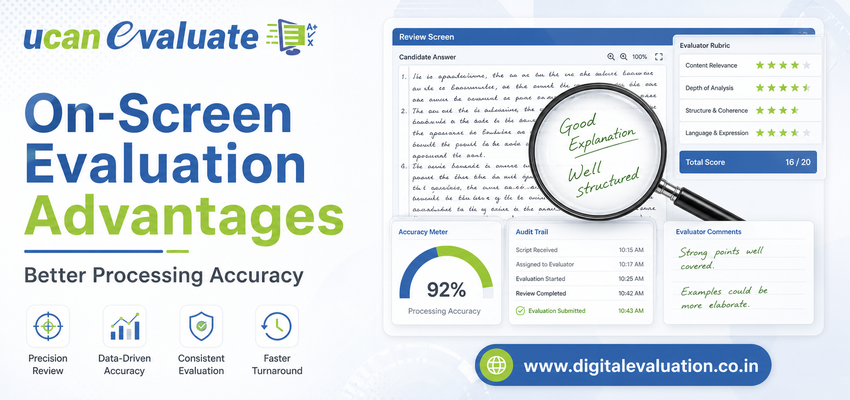
Every mark matters. For students, examination results determine academic progress, future opportunities and, in many cases, career decisions. For universities and examination boards, even a small evaluation error can lead to rechecking requests, result delays, administrative complications and reduced confidence in the assessment process.
But how can institutions maintain accuracy when thousands of answer booklets must be evaluated within strict timelines?
The answer lies in adopting a structured On Screen Evaluation System that combines digital technology, secure workflows and examiner-led assessment.
Unlike traditional paper-based evaluation, On-Screen Evaluation enables institutions to digitize answer scripts, allocate them to authorized evaluators, monitor marking progress and validate marks through a centralized platform.
From Answer Booklet Scanning to final result processing, a well-designed Digital Evaluation System makes examination operations more transparent, efficient and dependable.
Let’s explore nine important advantages of digital evaluation and understand how universities can strengthen accuracy throughout the examination lifecycle.
What Is an On Screen Evaluation System?
An On Screen Evaluation System is a technology-driven platform that allows examiners to evaluate scanned answer booklets electronically instead of checking physical scripts manually.
The process typically begins with the collection and digitization of answer sheets. The scanned scripts are uploaded to a secure platform, assigned to authorized evaluators and assessed using digital marking tools.
Examiners can view student responses, assign marks, make annotations and submit evaluated scripts without physically transporting answer booklets between locations.
A modern On-Screen Marking System also supports score validation, evaluator monitoring, audit records and integration with examination administration workflows.
This approach is part of the broader concept of electronic assessment, which uses digital technologies to support examination and evaluation activities.
For universities looking to modernize their assessment processes, the objective is not simply to replace paper with screens. It is to create a controlled evaluation environment where mistakes can be identified earlier, information remains traceable and academic decisions are supported by reliable records.
1. Reduces Manual Calculation and Marks Entry Errors
Traditional examination evaluation often requires examiners to mark individual answers, calculate totals, transfer scores and submit physical records for further processing.
Each manual step creates an opportunity for mistakes.
A properly configured On Screen Marking System helps reduce these risks through digital marks entry, automatic totaling and predefined validation rules.
For example, when an examiner enters marks for different questions, the system can automatically calculate the total according to the approved marking structure.
It can also flag marks that exceed the maximum permitted score or identify incomplete marking entries before submission.
This reduces reliance on repetitive calculations and helps prevent avoidable errors from affecting final results.
Importantly, technology supports the examiner’s judgment rather than replacing the academic expertise required to assess subjective responses.
2. Improves Accuracy Through High-Quality Answer Booklet Scanning
Accurate evaluation begins long before an examiner starts marking.
Poorly scanned pages, missing responses, incorrect booklet identification or incomplete document uploads can compromise the entire assessment process.
That is why Answer booklet scanning plays a critical role in successful digital examination workflows.
A systematic scanning process helps institutions capture complete, legible digital copies of handwritten answer scripts.
Barcode-based indexing, document verification and page-quality checks can support accurate mapping between physical booklets and their digital records.
Some scanning workflows may also use optical character recognition to extract suitable printed or handwritten information, although reliable evaluation of subjective answers still requires appropriate human oversight.
Universities planning a transition can explore this detailed guide to Scanning of Answer Sheets to understand the preparation, digitization and verification stages.
When scanning quality is controlled from the beginning, evaluators can focus on assessing student responses rather than resolving document-related complications.
3. Ensures More Consistent On-Screen Marking
Consistency is one of the biggest challenges in large-scale university examinations.
Different examiners may have different marking styles, and variations in interpretation can influence the assessment of subjective responses.
An effective On-Screen Marking System helps institutions establish structured marking workflows with configurable rubrics, question-wise marks distribution and moderation procedures.
These tools encourage evaluators to follow common assessment guidelines while allowing them to exercise academic judgment.
Digital annotations and comments can also make the evaluation process more organized and easier to review.
For examination authorities, this creates a stronger foundation for standardizing evaluation practices across departments, examination centers and geographically distributed examiner teams.
4. Strengthens Transparency and Auditability
What happens when a student challenges a result or a university needs to investigate an evaluation discrepancy?
In manual systems, retrieving and reviewing physical answer scripts can be time-consuming.
With Digital Evaluation, institutions can maintain structured records of marking activities and workflow decisions.
Depending on system configuration, an audit trail may capture evaluator assignments, score changes, timestamps, moderation decisions and approvals.
Such records help authorized administrators understand how an answer booklet moved through the evaluation process.
A well-designed system can therefore improve accountability, simplify internal reviews and support more transparent examination governance.
For universities managing high-stakes examinations, this traceability is particularly valuable.
5. Prevents Incomplete Evaluation and Missed Questions
One of the most frustrating examination errors occurs when a student has answered a question, but the response is unintentionally left unmarked.
Physical answer booklets can contain additional pages, optional questions, diagrams and lengthy responses. Under heavy workloads, an examiner may inadvertently overlook a section.
An advanced On Screen Evaluation System can help address this problem using question-wise marking status, page-navigation tools and completion checks.
Before an evaluated script is finalized, configured validation rules can identify unanswered marking fields or unresolved sections.
This provides an additional quality-control layer during Post Examination Processing.
Although digital checks cannot guarantee that every assessment judgment is correct, they can substantially improve the institution’s ability to identify incomplete evaluation workflows.
6. Accelerates Examination Processing Without Compromising Control
Universities often face pressure to publish semester results quickly while maintaining academic quality.
Manual examination workflows involve sorting, transporting, assigning, collecting and processing physical answer booklets.
These tasks can consume considerable administrative time.
A centralized Digital Evaluation System streamlines these operations by allowing authorized evaluators to access assigned digital scripts without waiting for physical deliveries.
Examination administrators can monitor progress, identify pending assignments and coordinate additional evaluation resources when needed.
This improves workflow visibility and can shorten turnaround times without removing essential moderation and verification stages.
Institutions can learn more about integrated Digital Evaluation workflows and their role in modern university examinations.
The real advantage is not speed alone. It is the ability to combine timely result processing with controlled, traceable and quality-focused evaluation.
7. Enhances Data Security and Confidentiality
Examination answer scripts contain sensitive academic information that must be handled carefully.
Traditional paper-based processes may expose institutions to risks associated with physical transportation, unauthorized handling and misplaced documents.
A secure On-Screen Evaluation environment can incorporate role-based permissions, controlled evaluator access, candidate identity masking, encryption and authentication measures.
These controls help restrict access to examination information based on authorized responsibilities.
When combined with appropriate institutional policies, access reviews and technical safeguards, digital evaluation can strengthen confidentiality throughout the marking process.
For universities, secure examination processing is essential not only for operational efficiency but also for maintaining student trust.
8. Improves Result Compilation and Post Examination Processing
Accurate marking is only one part of delivering trustworthy examination results.
Once answer scripts have been evaluated, universities must compile marks, perform verification, apply relevant examination rules and prepare final results.
Manual transfer of marks between disconnected systems can introduce transcription errors and reconciliation challenges.
An integrated University Examination System can help connect marking records with result-processing workflows.
Through configurable validation and approval mechanisms, examination teams can review consolidated marks before publication.
Integration with a University Management System may further support academic records, semester administration and other authorized institutional processes.
This creates an opportunity to reduce duplicate data entry while improving consistency between evaluation records and published outcomes.
For administrators, the result is a more manageable Examination Processing workflow with fewer avoidable handoffs.
9. Enables Better Monitoring, Quality Assurance and Continuous Improvement
One of the most valuable advantages of digital examination technology is the visibility it provides to examination administrators.
A modern On Screen Marking System can generate operational reports showing evaluation progress, pending workloads, examiner activity and quality-control requirements.
These insights make it easier to identify bottlenecks, redistribute assignments and prioritize scripts requiring additional attention.
Institutions can also introduce moderation and second-evaluation workflows where examination policies require them.
When supported by appropriate safeguards, AI-assisted checks may help identify unusual marking patterns or records requiring review.
However, automated analysis should remain an aid to quality assurance, not an unquestioned substitute for qualified examiners.
For more practical insights, explore On-Screen Marking and the role of AI-supported quality checks in modern assessment processes.
By combining human expertise with workflow analytics, institutions can continuously refine their evaluation procedures.
How On Screen Evaluation Fits into the Complete University Examination Lifecycle
The benefits of digital marking become even more valuable when connected to the broader examination ecosystem.
Before examinations, Pre Examination Processing may include student registration, examination scheduling, admit card generation and other administrative activities.
Question Bank Management supports the organized development, review and management of examination questions.
For computer-based examinations, an Online Examination System or Online Exam Solution helps institutions deliver assessments and capture candidate responses electronically.
For handwritten examinations, physical scripts are collected, scanned and processed through an On Screen Evaluation System.
After marking, Post Examination Processing connects approved scores with result compilation, verification and publication.
A coordinated approach to these workflows allows institutions to manage assessment information more consistently while reducing unnecessary administrative duplication.
Whether an institution uses paper-based examinations, Online Assessment platforms or a blended examination model, accurate and secure evaluation remains fundamental to successful examination management.
How Learning Spiral Ltd. Supports Accurate Digital Evaluation
Learning Spiral Ltd. helps universities, education boards and examination authorities modernize their assessment operations through technology-enabled examination solutions.
Its Digital Evaluation System supports essential stages of the evaluation lifecycle, including answer booklet digitization, secure script allocation, on-screen assessment, monitoring and marks processing.
Learning Spiral’s approach focuses on enabling institutions to:
Improve evaluation accuracy by reducing avoidable manual errors and calculation inconsistencies.
Support examiner productivity through organized digital marking interfaces and structured workflows.
Strengthen examination security with access controls, candidate identity masking and protected data handling.
Improve administrative visibility through progress monitoring, audit records and reporting capabilities.
Streamline examination operations by connecting evaluation activities with the broader university assessment lifecycle.
With solutions designed around the operational needs of universities and examination bodies, Learning Spiral supports institutions seeking more efficient, accountable and scalable evaluation workflows.
Frequently Asked Questions
What is the biggest advantage of an On Screen Evaluation System?
One of its most important advantages is reducing avoidable operational errors through digital marks entry, automated calculations, controlled marking workflows and review mechanisms.
How does On-Screen Evaluation improve examination accuracy?
It supports accurate evaluation by combining complete digital answer scripts, structured marking rules, score validation, audit trails and mechanisms for identifying incomplete marking.
Is On Screen Marking suitable for subjective examinations?
Yes. On Screen Marking is particularly useful for evaluating handwritten descriptive answers because qualified examiners can review scanned scripts, assign scores and add annotations electronically.
Can Digital Evaluation reduce examination result delays?
Yes. By reducing physical script movement, simplifying examiner allocation and integrating digital marks processing, institutions can improve evaluation turnaround times while maintaining necessary review and approval procedures.
How is an Online Examination System different from On Screen Evaluation?
An Online Examination System primarily manages the delivery of examinations and digital response collection. On Screen Evaluation focuses on assessing responses, particularly scanned handwritten answer booklets, through an electronic marking environment.
Conclusion: Better Examination Accuracy Begins with Better Evaluation Workflows
Examination accuracy is not determined by marking alone. It depends on how securely answer scripts are captured, how consistently evaluators work, how carefully scores are validated and how reliably results are processed.
An effective On Screen Evaluation System brings these activities into a more structured and transparent environment.
From Answer Booklet Scanning and On Screen Marking to final Examination Processing, digital workflows help universities reduce administrative risks, improve oversight and build greater confidence in examination outcomes.
For institutions planning to strengthen assessment quality, the priority should be a solution that combines dependable technology, examiner expertise, effective security controls and reliable result-processing procedures.
Ready to transform your institution’s examination evaluation process?
Connect with Learning Spiral Ltd. to explore secure, scalable and institution-focused Digital Evaluation solutions.