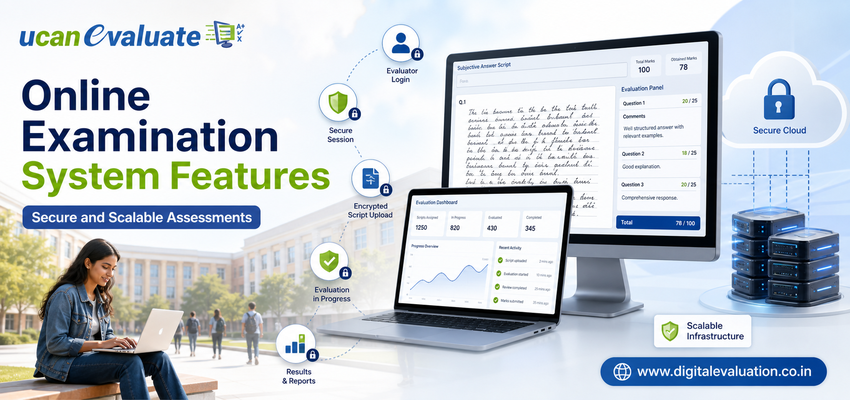
An examination system may work perfectly for 200 students and still struggle when 20,000 candidates log in together.
That is why universities and examination bodies evaluating an Online Examination System need to look beyond a simple test-taking interface.
A modern system must protect examination content, authenticate candidates, manage large concurrent volumes, handle different question formats, monitor examination activity, preserve audit trails and connect smoothly with evaluation and result processing.
The real goal is not simply to move an examination from paper to screen.
It is to create a secure, scalable and manageable digital examination lifecycle.
For universities planning digital transformation, understanding these capabilities can make the difference between merely conducting an online test and building a dependable examination ecosystem.
What This Article Covers
• What makes an Online Examination System secure and scalable
• 12 essential features universities should evaluate
• How Question Bank Management strengthens examination security
• Why scalability matters during peak examination periods
• How Online Assessment connects with Digital Evaluation
• Common mistakes universities make while choosing an exam platform
• A practical implementation checklist
• Frequently asked questions for examination administrators
What Is an Online Examination System?
An Online Examination System is a digital platform designed to create, schedule, deliver, monitor and manage examinations electronically.
Depending on the institution and examination model, it can support candidate registration, question-paper configuration, authentication, timed examinations, remote or centre-based assessment, automated scoring, subjective response handling, monitoring, reports and result processing.
The broader concept of Online Assessment includes the use of technology to conduct and manage assessments digitally.
But for universities, technology alone is not enough.
The system also needs to support institutional rules, examination security, peak candidate loads, academic workflows and downstream evaluation processes.
Why Secure and Scalable Assessment Matters
Universities may conduct semester examinations, entrance tests, recruitment assessments, supplementary exams, internal assessments and large multi-campus examinations.
Every examination brings different operational requirements.
A small internal assessment may involve a few hundred candidates, while a university entrance examination can involve thousands of simultaneous users.
The system therefore needs to maintain three things at the same time:
Security. Scalability. Examination continuity.
If any one of these fails, the examination process can be disrupted.
A secure system that cannot handle peak traffic is not sufficient.
A highly scalable system with weak candidate authentication is also insufficient.
The objective is to create a balanced architecture in which security and performance work together.
12 Essential Features of a Modern Online Examination System
1. Secure Candidate Authentication
The first challenge is straightforward:
Is the person taking the examination actually the authorised candidate?
A robust Online Examination System should provide controlled authentication before allowing access to the examination.
Depending on examination requirements, this may include:
• Unique credentials
• OTP-based authentication
• Identity verification
• Candidate photograph validation
• Registration-number verification
• Device or session controls
• Multi-factor authentication where required
The level of authentication should reflect the importance and risk level of the examination.
A low-stakes classroom assessment may not require the same controls as a university entrance or recruitment examination.
The important point is that candidate authentication should be configurable rather than treated as a single fixed process.
2. Secure Question Bank Management
Examination security begins long before the candidate clicks “Start Exam.”
Questions must first be created, reviewed, approved, categorized and stored securely.
A strong Question Bank Management environment can help universities maintain structured repositories based on parameters such as subject, unit, marks, difficulty level, question type and academic outcome.
This helps reduce dependence on scattered spreadsheets, email attachments and locally stored documents.
Useful capabilities may include:
• Role-based question creation
• Review and moderation workflows
• Difficulty-level tagging
• Subject and topic classification
• Multiple question formats
• Usage history
• Randomized selection
• Controlled approval workflows
• Secure paper generation
Question Bank Management becomes especially valuable when the institution conducts multiple examinations across departments, semesters and locations.
3. Randomized Question and Paper Generation
Every candidate receiving an identical question sequence can create avoidable examination-security risks.
A modern Online Exam Solution should support controlled randomization.
This can include:
• Random question selection
• Shuffled question order
• Shuffled answer options
• Multiple paper sets
• Rule-based paper generation
• Difficulty-balanced selection
Randomization should not mean uncontrolled randomness.
Universities must still ensure that equivalent papers remain academically balanced.
For example, each paper may need the same overall marks, difficulty distribution, syllabus coverage and question-type mix.
The platform should therefore combine randomization with academic rules.
4. Flexible Examination Configuration
Universities rarely conduct only one type of assessment.
One department may require MCQs.
Another may require numerical responses.
A professional programme may require case-based questions.
Another examination may need descriptive answers.
An effective Online Examination System should therefore support multiple question and response formats.
These may include:
• Multiple-choice questions
• Multiple-select questions
• True/false questions
• Numerical answers
• Short responses
• Descriptive questions
• Case-based assessment
• Image-based questions
• Diagram-based questions
• File-upload responses where applicable
The examination team should also be able to configure duration, attempt rules, navigation, marking schemes and examination windows.
5. Scalable Concurrent Examination Delivery
Scalability is one of the most important features of an Online Examination System—and one of the easiest to overlook during a demonstration.
A platform may work perfectly when ten administrators test it.
The real question is:
What happens when thousands of candidates attempt the examination simultaneously?
The system should be architected to handle expected peak loads without unacceptable degradation.
Universities should evaluate:
• Expected concurrent candidates
• Server capacity
• Load distribution
• Response time
• Database performance
• Failover planning
• Backup mechanisms
• Monitoring during live examinations
Scalability should be tested before examination day rather than discovered during it.
6. Proctoring and Examination Monitoring
Different assessments require different levels of supervision.
Some online examinations may be conducted from controlled university computer centres.
Others may involve distributed candidates.
Where required, examination monitoring can include:
• Candidate activity tracking
• Session monitoring
• Browser or navigation controls
• Camera-based proctoring
• Identity checks
• Suspicious-event flagging
• Proctor dashboards
• Examination logs
The objective should not be to add technology simply because it is available.
Monitoring controls should be proportionate to the examination, transparent to candidates and aligned with institutional policy.
7. Automatic Saving and Examination Continuity
Connectivity interruptions should not automatically destroy a candidate’s examination attempt.
A well-designed Online Examination System should periodically save candidate responses and maintain appropriate session continuity.
Useful controls may include:
• Automatic response saving
• Session recovery rules
• Connectivity-status monitoring
• Controlled re-login
• Time synchronization
• Examination-event logs
• Administrative exception handling
The institution should decide in advance what happens if:
• Connectivity drops
• A device fails
• Power is interrupted
• A candidate is disconnected
• A server or service becomes temporarily unavailable
An examination-continuity policy is as important as the technology supporting it.
8. Role-Based Access and Data Security
An examination ecosystem involves multiple stakeholders.
Faculty members may create questions.
Moderators may approve them.
Examination administrators may schedule tests.
Proctors may monitor candidates.
IT teams may manage infrastructure.
Not everyone should have access to everything.
Role-based access helps limit each user to the information and functions required for their responsibility.
Universities should look for controls such as:
• User-role management
• Permission-based access
• Controlled administrative privileges
• Secure login policies
• Activity logging
• Session management
• Examination-data protection
• Audit trails
This broader governance perspective is increasingly important as institutions adopt more AI-enabled and cloud-connected tools. Related discussion around AI and cybersecurity governance also emphasizes the importance of visibility, access management, monitoring and clear data-use controls when new technologies enter organizational workflows.
9. Automated and Structured Evaluation
For objective examinations, automatic scoring can significantly reduce manual work.
But university assessments frequently contain both objective and subjective questions.
This is where an online examination ecosystem may need to connect assessment delivery with evaluation workflows.
Objective questions can often be scored automatically according to configured rules.
Subjective responses require an evaluator workflow.
For paper-based descriptive examinations, physical scripts may follow:
Examination → Answer booklet scanning → Digital script → Evaluation
For digitally captured descriptive responses, the workflow may move directly into evaluation.
A connected Digital Evaluation System can help manage evaluator allocation, marking, moderation and marks processing after the examination.
10. Integration with On-Screen Evaluation
Universities do not need to choose between completely paper-based and completely online examinations.
Many institutions operate hybrid environments.
For example:
Path A:
Paper Examination → Scanning of Answer Sheets → On-Screen Evaluation → Result Processing
Path B:
Online Examination → Digital Response Capture → Evaluation → Result Processing
An On-Screen Evaluation workflow is particularly relevant where universities continue to use handwritten answer booklets but want to digitize assessment after the examination.
This allows institutions to modernize different stages at different speeds.
The larger objective should be an integrated University Examination System rather than disconnected software applications.
11. Real-Time Examination Monitoring and Dashboards
During a large examination, administrators should not have to rely on phone calls and spreadsheets to understand what is happening.
A useful examination dashboard can provide visibility into operational metrics such as:
• Candidates expected
• Candidates logged in
• Candidates absent
• Active sessions
• Completed examinations
• Interrupted sessions
• Flagged incidents
• Examination-centre status
• Subject or paper status
Real-time visibility helps examination teams identify problems early rather than discovering them after the examination ends.
For large-scale Examination Processing, this operational visibility can be as important as the candidate interface itself.
12. Post Examination Processing and Result Integration
The examination does not end when the candidate submits the final response.
Marks may still need to be validated, moderated, consolidated and integrated into the institution’s result workflow.
A strong Online Examination System should therefore consider Post Examination Processing from the beginning.
Depending on institutional requirements, this may include:
• Score calculation
• Negative-marking rules
• Marks verification
• Subject-wise consolidation
• Internal and external marks integration
• Moderation
• Grade calculation
• Result approval
• Result publication
• Revaluation or grievance workflows
• Reporting and analytics
The fewer times examination data needs to be manually exported, reformatted and re-entered, the lower the opportunity for avoidable administrative errors.
Security Should Cover the Entire Examination Lifecycle
One of the biggest mistakes institutions make is treating security as an exam-day feature.
Security actually begins during Pre Examination Processing.
Questions must be protected.
Approvals must be controlled.
Candidate data must be managed appropriately.
Examination configuration must be restricted to authorised users.
During the examination, candidate authentication, session controls and monitoring become important.
After the examination, response data, marks and result information must continue to be protected.
The security model therefore needs to cover:
Pre Examination Processing → Examination Delivery → Evaluation → Post Examination Processing
A secure login page by itself does not create a secure examination ecosystem.
Scalability Is More Than Server Capacity
When universities hear “scalable,” the discussion often focuses entirely on concurrent users.
That is only one dimension.
A scalable University Examination System should also support growth in:
• Number of examinations
• Academic programmes
• Subjects
• Question repositories
• Examination centres
• Evaluators
• Candidates
• Reporting requirements
• Historical records
• Integrations
It should also remain manageable as the institution’s examination complexity increases.
Technology that works for one department should not require complete redesign when adopted university-wide.
Online Assessment Can Support Different Examination Models
Digital transformation does not mean every university must conduct every examination in exactly the same format.
Institutions may use Online Assessment for:
• Entrance examinations
• Recruitment tests
• Internal assessments
• Practice tests
• Continuous assessment
• Certification examinations
• Semester examinations
• Supplementary examinations
More advanced models may also include forms such as adaptive Online Assessment, where question selection can change based on a candidate’s responses.
The correct assessment model should always be determined by academic objectives rather than technology trends.
Common Mistakes When Selecting an Online Examination System
1. Choosing Based Only on the Candidate Interface
A polished examination screen does not reveal how the system handles security, peak loads, exceptions, evaluation or result processing.
Better approach: Evaluate the complete examination lifecycle.
2. Ignoring Peak-Load Testing
A platform that works during a demonstration may behave differently when thousands of candidates log in simultaneously.
Better approach: Conduct realistic load and scalability testing.
3. Treating Question Management as a Separate Problem
Weak question preparation can compromise an otherwise secure examination.
Better approach: Integrate Question Bank Management with examination delivery.
4. Overlooking Subjective Evaluation
Universities frequently conduct examinations containing long-form responses.
Better approach: Confirm how subjective answers move into On Screen Marking or evaluation workflows.
5. Ignoring Exception Scenarios
Institutions often design around the ideal candidate journey.
Real examinations include connectivity failures, absent candidates, device problems and administrative interventions.
Better approach: Test exception workflows before live deployment.
6. Selecting Features Without Mapping the Existing Process
More features do not automatically produce better examination management.
Better approach: Map the current workflow first, identify bottlenecks and then evaluate technology against those needs.
A Practical Checklist for Universities
Before selecting or upgrading an Online Examination System, ask these questions:
- Can the system securely authenticate candidates?
- Can it manage questions through controlled Question Bank Management workflows?
- Does it support multiple question types and examination patterns?
- Can it handle our expected peak candidate load?
- What happens if connectivity or a candidate device fails?
- Can examination administrators monitor live activity?
- Does it provide meaningful audit trails?
- Can objective questions be scored automatically?
- How are subjective responses evaluated?
- Can it integrate with our existing University Examination System or University Management System?
- How does examination data move into Post Examination Processing?
- What implementation, training and live-exam support are available?
These questions reveal far more than a generic software feature list.
How Learning Spiral Ltd. Supports Digital Examination Transformation
A successful examination platform needs to understand the operational realities of universities and examination bodies—not only software development.
Learning Spiral Ltd. works across examination and assessment workflows, supporting institutions with solutions spanning Online Assessment, examination management, Question Bank Management, Digital Evaluation and related examination-processing requirements.
The company’s official website highlights its long-standing work with universities, higher-education institutions and examination bodies, including digital examination and evaluation workflows.
The value of an integrated approach is simple:
Pre Examination Processing → Online Examination → Digital Evaluation → Post Examination Processing
When these stages communicate effectively, institutions gain better visibility, stronger control and fewer manual dependencies across the examination lifecycle.
Final Thoughts
The best Online Examination System is not simply the platform with the longest feature list.
It is the system that can reliably answer the questions examination administrators care about most:
Is the right candidate taking the examination?
Are examination questions protected?
Can the system handle peak traffic?
What happens when something goes wrong?
Can administrators see what is happening in real time?
Can responses move efficiently into evaluation?
Can verified marks move securely into result processing?
When these requirements are addressed together, an Online Exam Solution becomes much more than a digital replacement for a physical examination hall.
It becomes the foundation of a secure, scalable and connected examination ecosystem.
For universities, boards and examination bodies considering digital transformation, the smartest starting point is to map the complete examination lifecycle first—and then select technology capable of supporting it from question creation to final result.
Frequently Asked Questions
1. What are the most important features of an Online Examination System?
The most important features include secure candidate authentication, Question Bank Management, configurable examinations, scalability, examination monitoring, automatic saving, access control, audit trails, evaluation workflows, dashboards and result integration.
2. How does an Online Examination System improve examination security?
It can introduce controlled authentication, role-based access, secure question management, randomized papers, examination monitoring, activity logs and structured administrative permissions. Security requirements should be configured according to the examination’s risk level.
3. Can an Online Examination System handle thousands of students?
A properly architected system can be designed for large concurrent examinations, but institutions should validate expected peak loads through realistic performance testing before implementation.
4. How is Online Assessment connected with Digital Evaluation?
Online Assessment captures candidate responses digitally. Objective responses can often be scored automatically, while subjective answers may be routed to evaluators. Digital Evaluation then supports marking, moderation, verification and downstream result processing.
5. Can universities use online exams and handwritten examinations together?
Yes. Universities can use a hybrid examination model. Some assessments can be delivered through an Online Examination System, while handwritten examinations can move through Answer booklet scanning, On-Screen Evaluation and Digital Evaluation.
6. What is the role of Question Bank Management in online examinations?
Question Bank Management helps institutions create, classify, review, approve and securely store questions before examination delivery. It can also support rule-based paper generation, randomization and controlled access.
7. What should universities check before selecting an Online Exam Solution?
Universities should evaluate examination workflow fit, candidate authentication, question security, scalability, monitoring, subjective evaluation, integrations, audit trails, exception management, result processing and implementation support.