For students, an examination may begin when the question paper appears on screen and end when they submit their responses.
For a university, however, the assessment journey begins much earlier and continues long after the final answer is submitted.
Student data must be prepared. Subjects need to be mapped. Question papers must be created and secured. Examination schedules and candidate credentials must be managed. Responses or answer scripts must then be evaluated, moderated, verified and converted into publishable results.
When these activities operate through disconnected systems, universities may face repeated data entry, administrative delays, reconciliation issues and limited visibility across the examination cycle.
An integrated approach changes that.
By connecting Pre Examination Processing, Online Assessment, Digital Evaluation and Post Examination Processing, institutions can create a continuous examination workflow in which information moves securely from one stage to the next.
The result is not simply a digital examination. It is a more connected, manageable and scalable assessment ecosystem.
Online Assessment Should Begin Before the Exam Starts
A successful assessment does not begin when candidates click “Start Exam.”
Much of the work that determines whether an examination runs smoothly happens beforehand.
Pre-exam operations can involve candidate registration, programme and subject mapping, examination scheduling, eligibility verification, centre allocation, hall-ticket generation, question preparation and user-access configuration.
When these activities depend heavily on spreadsheets, emails and isolated applications, examination teams may spend considerable time transferring and validating information.
A connected Pre Examination Processing workflow can bring these activities into a structured system.
Candidate information can move forward without being repeatedly entered at each stage. Examination rules can be configured in advance. Subject and paper mappings can be validated before the examination begins.
This creates a stronger operational foundation for the complete assessment lifecycle.
Question Preparation Is Part of the Assessment Workflow
Before an examination can be conducted, institutions need a secure and organised method for preparing assessment content.
A structured Question Bank Management system can help examination teams store, organise, review and manage question items according to subjects, topics, difficulty levels and other academic parameters.
Instead of preparing every paper through disconnected documents and email exchanges, authorised teams can maintain a controlled repository of questions and use defined workflows for authoring, moderation and paper creation.
This becomes particularly useful for institutions managing multiple programmes, departments, examinations and academic sessions.
Question preparation therefore should not be viewed as a separate administrative activity. It is the first major academic component of an integrated examination workflow.
Connecting Question Banks with an Online Examination System
Once the assessment content is ready, the next challenge is secure examination delivery.
A modern Online Examination System should connect question preparation, candidate authentication, examination delivery and response management rather than treating each process independently.
This allows approved assessment content to move securely into the examination environment while reducing unnecessary manual intervention.
Institutions may also need to manage different examination patterns, question types, candidate volumes, academic rules and security requirements.
The goal is therefore not simply to replace a paper examination with a computer screen.
A well-designed online examination workflow should help institutions maintain control before, during and after the test.
Why Integrated Online Assessment Matters
Online Assessment broadly refers to the use of digital technology to conduct and support assessment activities.
For universities, however, the real operational opportunity lies in connecting assessment delivery with the processes around it.
Consider what happens when the online examination platform operates independently from student records, question preparation and result processing.
Candidate data may have to be imported manually.
Subject mappings may need additional verification.
Marks may require separate exports.
Result-processing teams may then need to reconcile different files before final grades can be generated.
An integrated environment reduces these handoffs.
The examination becomes one stage within a continuous digital workflow rather than an isolated event.
What Happens After the Examination?
Completing an examination does not mean the institution’s work is finished.
In many universities, the post-exam phase can be more operationally demanding than the examination itself.
Responses need to be collected and organised. Written answer booklets may need to be scanned. Evaluators have to be assigned. Marks must be captured and validated. Moderation or re-evaluation may be required. Finally, approved scores need to move into result-processing workflows.
This is where Post Examination Processing becomes critical.
When the post-exam stage is digitally connected with examination and evaluation systems, institutions can reduce unnecessary movement of files, manual consolidation and repetitive data handling.
Answer Booklet Scanning Bridges Paper and Digital Evaluation
Not every university examination needs to become completely computer-based.
Many institutions continue to conduct written examinations while digitising the evaluation stage.
In such cases, Answer Booklet Scanning creates the bridge between physical examinations and digital marking.
After written answer scripts are collected, they can be digitised and organised so that authorised evaluators can access them electronically.
The Scanning of Answer Sheets must be systematic because the quality of the digital script directly affects the evaluation workflow that follows.
Proper indexing and mapping also help ensure that each digitised script is associated with the correct examination record while maintaining required confidentiality.
This hybrid approach allows institutions to preserve familiar written examination formats while modernising evaluation and result processing.
On-Screen Evaluation Removes Physical Script Movement
Once answer scripts are digitised, they can move into On Screen Evaluation.
Instead of physically sending bundles of answer booklets to evaluators, authorised evaluators can access digitised scripts through a controlled environment.
An On Screen Evaluation System can support structured evaluator allocation, digital marking, validation controls, moderation and progress monitoring.
This helps universities create greater visibility into the evaluation process.
Examination administrators can better understand how much evaluation has been completed, where delays are occurring and whether scripts are moving through the required workflow.
On-Screen Marking Creates a More Structured Evaluation Process
On-Screen Marking is not merely the digital equivalent of placing marks on a paper answer script.
A structured On Screen Marking System can help institutions define evaluation rules, allocate scripts securely, monitor evaluator activity and reduce avoidable manual calculations.
Evaluators can work with digitised scripts while examination administrators maintain central visibility over the evaluation cycle.
This becomes especially useful when examinations involve large numbers of answer scripts, multiple evaluators or geographically distributed evaluation teams.
Digital marking can therefore transform evaluation from a physically distributed process into a centrally manageable workflow.
Digital Evaluation Should Connect Directly to Results
Digital Evaluation becomes significantly more valuable when it is connected with the stages that come after marking.
Once evaluation is completed, marks may still need validation, moderation, compilation and integration with student records.
If evaluation data is exported into multiple spreadsheets and manually re-entered into another application, institutions lose many of the advantages of digitising the marking process.
An integrated Digital Evaluation System can help move validated marks forward into result-processing workflows without unnecessary duplication.
That connection is one of the most important differences between simply digitising marking and transforming the complete examination lifecycle.
Post Examination Processing Turns Marks into Results
The post-examination phase typically brings together multiple academic and administrative activities.
These may include:
1. Marks Consolidation
Evaluated marks from different papers, components or assessment formats need to be compiled into a structured record.
2. Validation and Verification
Institutions may apply rules to identify missing marks, unusual entries or incomplete evaluations before results are processed.
3. Moderation and Re-Evaluation
Where institutional policy requires it, scripts or marks may move through moderation, scrutiny or re-evaluation workflows.
4. Grade and Result Processing
Approved marks can then be processed according to applicable academic rules.
5. Result Publication
Once verification is complete, final results can be prepared for authorised release.
Connecting these stages reduces the gap between the completion of evaluation and the declaration of results.
A University Examination System Should Connect the Whole Cycle
The biggest advantage of integration appears when institutions stop viewing pre-exam, examination, evaluation and result processing as separate technology projects.
A modern University Examination System can connect these stages into one broader operational framework.
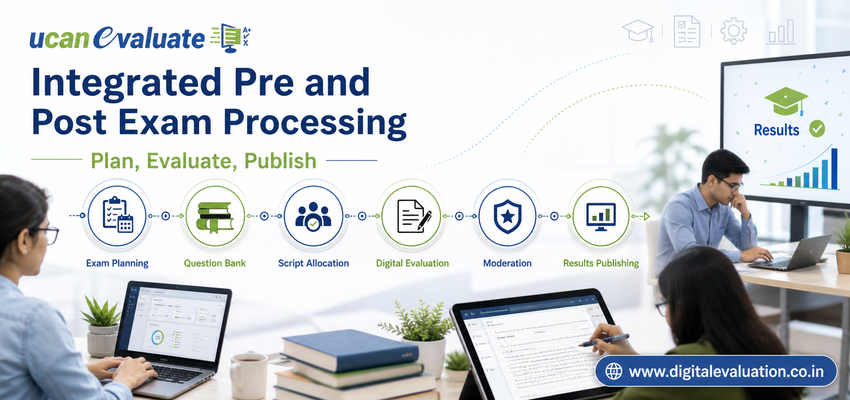
The examination lifecycle may then flow from:
1. Candidate and academic data preparation
↓
2. Question Bank Management
↓
3. Pre Examination Processing
↓
4. Online Examination or written examination delivery
↓
5. Answer Booklet Scanning where required
↓
6. On-Screen Evaluation and On-Screen Marking
↓
7. Moderation and verification
↓
8. Post Examination Processing
↓
9. Final result preparation
This connected model creates continuity across the examination cycle.
Why Integration Improves Examination Processing
Integrated Examination Processing is valuable because delays often occur between processes rather than within an individual application.
For example, a university may already have separate systems for student registration, examination delivery and evaluation.
But if information has to be transferred manually between them, examination teams may still experience bottlenecks.
Integration can help address this in several ways.
1. Reduced Duplicate Data Entry
Candidate, course and examination information can move between stages without requiring teams to repeatedly recreate the same records.
2. Better Process Visibility
Administrators can see where a particular examination stands instead of depending on updates from multiple teams.
3. More Structured Handoffs
When one stage is completed, validated data can move into the next defined workflow.
4. Improved Auditability
Digital workflows can make it easier to maintain records of important actions and process stages.
5. Faster Administrative Coordination
Examination departments, evaluators and result-processing teams can work from connected information rather than disconnected versions of files.
Technology Should Support Educators, Not Add Another Layer of Complexity
The growth of AI, smartphones and digital learning is changing how students access information and how educators guide learning.
This wider shift also affects how institutions should think about Online Assessment.
Technology is most useful when it removes repetitive administrative work while preserving the academic judgment of educators.
Examination systems should therefore make workflows easier to manage without making academic processes unnecessarily complicated.
The objective is not to automate every decision.
It is to ensure that faculty members and examination teams can focus their time on activities where academic expertise matters most.
Pre and Post Exam Integration Supports Better Data Continuity
One of the less visible advantages of an integrated system is continuity of data.
Information created during Pre Examination Processing can continue to support later stages.
Candidate identities, programme mappings, subject codes and examination records can remain connected throughout the cycle.
Similarly, marks generated through On-Screen Marking can move into post-examination workflows without losing their relationship to the original examination record.
This creates a more coherent assessment data lifecycle.
For a University Management System, that continuity can be important because examination information eventually becomes part of broader academic records.
What Universities Should Look for Before Integrating Exam Workflows
Institutions evaluating an integrated assessment environment should consider more than individual feature lists.
A useful evaluation should ask whether the system can support the complete operational journey.
1. Can pre-exam information flow into the examination platform?
Candidate, course, subject and paper information should not require unnecessary duplication.
2. Can question preparation connect securely with examination delivery?
The workflow should maintain appropriate confidentiality and authorised access.
3. Can written examinations connect with digital evaluation?
If paper answer scripts are used, the system should support efficient Answer Booklet Scanning and digital script management.
4. Can evaluation progress be monitored centrally?
Administrators should have appropriate visibility into evaluator allocation and completion.
5. Can evaluated marks flow into Post Examination Processing?
The process should minimise unnecessary exports, re-entry and reconciliation.
6. Can the platform scale with institutional requirements?
Universities may operate multiple programmes, campuses, examination types and academic rules.
The system should support that complexity without fragmenting the workflow.
How Learning Spiral Supports Connected Examination Workflows
Learning Spiral Ltd. works with universities and examination bodies across multiple stages of the assessment lifecycle.
Its examination technology ecosystem covers areas such as Question Bank Management, Pre Examination Processing, Online Examination System, Online Assessment, Answer Booklet Scanning, On Screen Evaluation, On-Screen Marking, Digital Evaluation and Post Examination Processing.
The key value of combining these processes is continuity.
Instead of modernising one isolated activity, institutions can work toward an examination environment where each stage supports the next.
That can help examination teams create more structured workflows from question preparation and assessment delivery through digital marking and result processing.
The Future of Online Assessment Is End-to-End
The next stage of examination transformation will not be defined only by moving tests online.
Universities increasingly need assessment systems that understand the complete examination lifecycle.
An effective Online Exam Solution should connect what happens before the examination, during assessment, during evaluation and after marking.
Pre Examination Processing establishes the foundation.
The Online Examination System manages secure delivery.
Answer Booklet Scanning connects written examinations with digital workflows.
On-Screen Evaluation and On-Screen Marking structure the evaluation stage.
Post Examination Processing moves validated academic data toward final results.
When these systems work together, assessment becomes more than a digital event.
It becomes a connected institutional process.
Final Thoughts
Enhancing Online Assessment requires universities to look beyond the examination interface itself.
The strongest improvement often comes from integrating everything around the exam.
A connected workflow reduces fragmented processes, strengthens visibility and helps examination data move more smoothly from preparation to final results.
For universities and examination bodies planning to modernise their examination processes, the question should therefore not be:
“How do we conduct an exam online?”
A better question is:
“How do we connect the complete examination lifecycle – from question preparation and candidate processing to evaluation and result declaration?”
That is where integrated examination technology creates its greatest value.
Transform Your Examination Workflow with Learning Spiral
Build a more connected assessment journey with Learning Spiral Ltd., covering Pre Examination Processing, Online Examination System, Digital Evaluation, On-Screen Marking, Answer Booklet Scanning and Post Examination Processing.