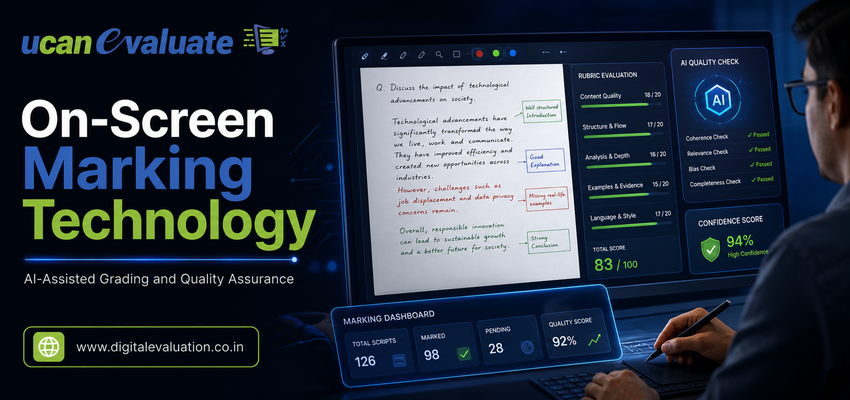
A university can digitize thousands of answer sheets, allocate them to evaluators and complete marking faster than before. But one important question still remains:
How do you make sure evaluation quality stays consistent across different evaluators, subjects, locations and examination cycles?
This is where AI-assisted On-Screen Marking can add a new layer of intelligence to Digital Evaluation.
Traditional digital marking already replaces the physical movement of answer booklets with secure, screen-based evaluation. AI-assisted workflows can take this a step further by helping examination teams identify unusual marking patterns, missed responses, workflow exceptions and quality-control signals that may require human review.
The objective is not to remove the evaluator.
It is to give evaluators, moderators and examination administrators better tools to maintain accuracy, consistency and accountability at scale.
What Is AI-Assisted On-Screen Marking?
On-Screen Marking is the digital evaluation of scanned or electronically submitted examination responses through a secure interface. Evaluators view scripts on a screen, assign marks, add annotations where required and complete evaluation without physically handling answer booklets.
In an AI-assisted environment, technology can support this workflow by analysing process signals, identifying potential anomalies and directing attention toward scripts or marking behaviour that may require additional verification.
A modern On-Screen Evaluation workflow can therefore combine human academic judgment with digital process controls and technology-assisted quality assurance.
The important word here is assisted.
For subjective examinations, academic judgment, context, interpretation and rubric application remain important evaluator responsibilities. AI should strengthen the quality-control layer rather than operate as an unchecked replacement for qualified examiners.
Why Digital Marking Needs More Than Speed
Moving from physical checking to a Digital Evaluation System can substantially simplify examination logistics, but speed alone should never define a successful evaluation process.
Universities also need to ask:
- Was every required response evaluated?
- Were marks entered within the permitted range?
- Are evaluators applying the marking scheme consistently?
- Are unusual scoring patterns being reviewed?
- Can moderators identify where intervention is required?
- Is there an auditable record of evaluation activity?
These questions become increasingly important when thousands or even lakhs of scripts are distributed across large evaluator teams.
A well-designed On Screen Marking System should therefore improve not only turnaround time but also visibility into the evaluation process.
From Answer Booklet to Evaluation Screen
AI-assisted grading cannot compensate for poor input quality.
The process begins with accurate Answer booklet scanning. Physical answer scripts must be converted into complete, readable and correctly mapped digital records before they reach an evaluator.
The Digital Evaluation workflow can then follow a controlled sequence:
- Answer script identification: Each booklet is associated with the correct examination record.
- Scanning of Answer Sheets: Every required page is captured with sufficient clarity for evaluation.
- Quality verification: Missing, blurred, rotated or incorrectly sequenced pages can be identified before marking begins.
- Secure allocation: Digital answer scripts are assigned to authorised evaluators according to the institution’s workflow.
- On-Screen Marking: Evaluators review responses digitally and record marks in the system.
- Quality assurance: Process controls and AI-assisted checks can help identify exceptions requiring attention.
- Moderation and approval: Authorised academic teams can review scripts or evaluator performance where necessary.
- Post Examination Processing: Approved marks move toward compilation, result processing and publication.
This connected workflow is what turns simple scanning into a structured Digital Evaluation process.
How AI Can Strengthen Quality Assurance
AI becomes useful when it helps examination teams focus attention where it is most needed.
1. Identifying Unusual Marking Patterns
In large evaluation exercises, different evaluators may naturally display some variation in marking behaviour.
Technology can help identify unusual patterns such as unexpectedly high or low scoring tendencies, abrupt changes in an evaluator’s marking behaviour or results that fall outside expected process ranges.
Such signals should not automatically be treated as errors. Instead, they can help moderators determine where a closer human review may be worthwhile.
2. Supporting Checks for Missed Evaluation
One of the risks in high-volume assessment is an unanswered evaluation action—for example, a response that should have been reviewed but was accidentally skipped.
Digital workflows can create validation checks before a script is submitted as complete.
This helps make the On-Screen Marking process more structured than a purely paper-based workflow in which such exceptions may be harder to identify immediately.
3. Improving Consistency Around Marking Rules
An On-Screen Marking System can help keep approved marking schemes, maximum marks, question-level rules and evaluation instructions close to the evaluator’s workflow.
AI-assisted or rule-based alerts can further support quality assurance by highlighting situations that fall outside configured parameters.
The goal is not to tell an academic evaluator what every subjective answer deserves. It is to reduce avoidable process inconsistency around the evaluation itself.
4. Helping Moderators Prioritise Review
Moderation becomes difficult when administrators have thousands of evaluated scripts but limited time to decide which ones deserve additional scrutiny.
Instead of treating every script identically, data-driven quality controls can help moderators identify potentially unusual cases and prioritise human review.
This makes technology a decision-support layer rather than an academic decision-maker.
5. Creating Better Examination Insights
Once evaluation activity becomes digital, universities can analyse more than final marks.
They can study evaluation progress, turnaround time, question-wise patterns, moderation requirements and operational bottlenecks.
These insights can improve future Examination Processing and help administrators understand where evaluator support, question design or workflow controls may need improvement.
AI Should Support the Evaluator, Not Replace Academic Judgment
AI is becoming increasingly visible throughout education, but its value depends on how thoughtfully it is used.
The broader conversation around AI in education also reinforces an important principle: technology is most useful when it strengthens human decision-making rather than attempting to replace the judgment, context and mentoring that education professionals provide.
The same principle applies to On Screen Evaluation.
A subjective answer may contain an unconventional but valid argument, an alternative method of solving a problem, partially correct reasoning or context that requires subject expertise.
These are areas where trained evaluators remain essential.
AI-assisted grading should therefore be designed around human-in-the-loop quality assurance.
Technology can help surface signals. Evaluators and moderators remain responsible for academic decisions.
How On-Screen Marking Improves Evaluation Control
A robust Digital Evaluation System can make several quality-control practices easier to operationalise.
1. Structured Question-Wise Marking
Marks can be entered against specific questions rather than manually totalled across physical pages.
This creates greater structure and can reduce avoidable calculation or transcription errors.
2. Evaluator Accountability
Digital evaluation creates process records that can help examination administrators understand allocation, evaluation progress and completion status.
Instead of waiting for physical bundles to return, administrators gain better visibility into the evaluation cycle.
3. Secure Script Handling
Digitisation reduces the physical movement of original answer booklets during evaluation.
Depending on system configuration, candidate identity can also be protected from evaluators to support impartial assessment.
4. Multiple Evaluation and Moderation Workflows
Where institutional policy requires moderation, review or multiple valuations, digital scripts can be routed through defined workflows without repeatedly moving original answer books.
5. Faster Mark Compilation
Because marks are already recorded digitally, they can move more efficiently into downstream Post Examination Processing once the required review and approval steps are complete.
Where Online Assessment Fits into the Bigger Picture
Digital assessment is broader than on-screen marking alone.
Online Assessment can include computer-based examinations, electronic responses and other digitally administered assessments. On-Screen Marking, by contrast, is particularly valuable when institutions want to continue conducting handwritten examinations while digitising the evaluation stage.
That distinction matters.
A university does not necessarily need to replace every pen-and-paper examination to modernise its assessment workflow.
It can preserve handwritten examination formats where appropriate while using Answer booklet scanning and Digital Evaluation to modernise what happens after students submit their scripts.
Question Quality Still Matters
Technology can improve evaluation control, but it cannot compensate for poorly designed examination questions.
A structured Question Bank Management process helps institutions organise test items, academic metadata, difficulty levels and question histories before an examination reaches the evaluation stage.
This creates an important connection between Pre Examination Processing and Digital Evaluation.
Better-controlled question creation supports clearer marking expectations. Clearer marking expectations can make On-Screen Marking more consistent. Better evaluation data can then provide insights that help improve future examination cycles.
The entire assessment lifecycle is connected.
Connecting On-Screen Marking with the University Examination System
On-Screen Marking delivers the greatest operational value when it does not function as an isolated application.
A modern University Examination System can connect examination planning, Question Bank Management, candidate workflows, scanning, evaluation, moderation, marks processing and result publication.
When these stages communicate with one another, administrators spend less time transferring information manually between disconnected systems.
This also improves traceability.
Instead of managing separate records for scanning, evaluator allocation, marking and results, institutions can build a more connected examination lifecycle.
What Should Universities Look for in an On-Screen Marking System?
Before selecting or upgrading a solution, institutions should evaluate the complete operational workflow rather than focusing only on the evaluator interface.
Consider the following:
- Scanning quality: Can the workflow ensure that answer scripts are complete and readable before evaluation?
- Security: How are candidate data, scripts and evaluator access protected?
- Allocation flexibility: Can scripts be distributed according to subject, evaluator availability or institutional rules?
- Ease of marking: Can evaluators comfortably navigate scripts, enter marks and review responses?
- Quality assurance: Does the system support moderation, exception handling and review workflows?
- Auditability: Can examination administrators trace relevant evaluation activity?
- Scalability: Can the platform support peak examination volumes without disrupting workflows?
- Integration: Can evaluation data connect effectively with marks processing and result publication?
- Reporting: Can administrators monitor progress and identify bottlenecks?
- Human oversight: Are AI or automated controls designed to support authorised academic decision-makers rather than bypass them?
These considerations are more important than simply asking whether a platform allows answer sheets to be viewed on a computer screen.
AI-Assisted Grading Is Also About Better Quality Assurance
The phrase “AI grading” can create the impression that a machine independently decides every student’s marks.
For subjective examinations, that is an unnecessarily narrow way to think about the opportunity.
AI can be equally valuable as a quality-assurance layer.
It can support monitoring, identify patterns, flag exceptions and help examination teams use evaluation data more intelligently.
This approach keeps academic judgment where it belongs—with authorised educators—while using technology to reduce process blind spots.
That balance can be especially important for universities and examination boards handling large-scale assessment cycles.
Building a Connected Digital Examination Journey
On-Screen Marking is only one part of examination transformation.
An integrated Online Exam Solution can connect Pre Examination Processing, Online Examination System workflows, Answer booklet scanning, On Screen Evaluation, Digital Evaluation and Post Examination Processing into a more coordinated journey.
Instead of solving individual operational problems one by one, institutions can build an examination architecture in which information moves securely from one stage to the next.
This can improve administrative visibility while reducing dependence on repetitive manual coordination.
How Learning Spiral Supports Digital Evaluation
Learning Spiral Ltd. works with universities, education boards and examination bodies to digitise and streamline examination workflows.
Its Digital Evaluation and On-Screen Marking approach is designed around the complete evaluation journey—from Scanning of Answer Sheets and digital script allocation to evaluator workflows, quality control, marks processing and result-related activities.
For institutions evaluating AI-assisted assessment technologies, the goal should not simply be “more automation.”
The better goal is better-controlled automation—technology that supports evaluator productivity, institutional visibility, academic quality and student trust.
Final Thoughts
On-Screen Marking has already changed the way institutions can evaluate handwritten examinations.
The next opportunity is to make that digital process smarter.
AI-assisted grading and quality assurance can help examination teams identify exceptions earlier, monitor evaluation more intelligently and strengthen consistency across large assessment operations.
But technology should not remove the human judgment at the heart of subjective assessment.
The strongest Digital Evaluation model combines both:
Human academic expertise to make evaluation decisions, and intelligent technology to make the process easier to control, monitor and improve.
For universities and examination bodies planning the next stage of examination transformation, an AI-assisted On-Screen Marking System can become an important part of a secure, scalable and quality-focused assessment ecosystem.
Frequently Asked Questions
1. What is an On-Screen Marking System?
An On-Screen Marking System allows evaluators to review digitised answer scripts on a computer screen, enter question-wise marks, use permitted annotations and complete evaluation without physically handling answer booklets.
2. Can AI completely grade subjective university answer sheets?
AI can support specific assessment and quality-assurance activities, but subjective responses often require academic judgment, context and interpretation. A human-in-the-loop approach is more appropriate where qualified evaluators remain responsible for final academic decisions.
3. How does Answer booklet scanning support Digital Evaluation?
Answer booklet scanning converts handwritten examination scripts into readable digital records. Accurate scanning ensures evaluators receive complete, correctly sequenced and legible scripts for On Screen Evaluation.
4. How can AI improve evaluation quality assurance?
Depending on system design, AI and automated controls can help identify unusual patterns, workflow exceptions, incomplete evaluation actions and cases that may require moderation or additional human review.
5. Can On-Screen Marking integrate with examination processing?
Yes. A connected Digital Evaluation System can form part of a broader examination workflow covering Pre Examination Processing, scanning, evaluator allocation, On Screen Marking, moderation, marks compilation and Post Examination Processing.