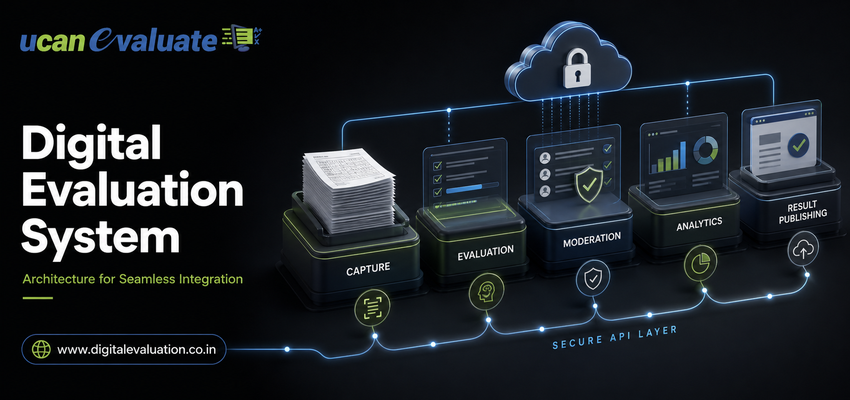
A Digital Evaluation System may look simple from the evaluator’s screen.
An examiner logs in, opens a digitised answer booklet, checks responses, enters marks and submits the evaluation.
But behind that seemingly simple experience lies a much larger technology ecosystem.
Answer scripts must first be scanned accurately. Each booklet must be identified correctly. Digital files need secure storage. Scripts must reach the right evaluator. Marks need validation. Moderation must be controlled. Examination data must communicate with university systems. And, finally, approved marks need to move into result processing without recreating manual work.
That is why successful Digital Evaluation depends not only on the marking interface but also on the architecture supporting the entire workflow.
A well-designed architecture connects:
Answer Booklet Scanning → Script Identification → Secure Storage → Examiner Allocation → On Screen Evaluation → On Screen Marking → Moderation → Marks Integration → Post Examination Processing
When these stages work together, universities can move from isolated digitisation toward a truly connected examination environment.
What Is Digital Evaluation System Architecture?
Digital Evaluation System architecture refers to the technology, data, workflows and integrations that work together to digitise the assessment of answer scripts.
Instead of viewing Digital Evaluation as a standalone application, universities should think of it as an interconnected layer within the broader University Examination System.
A typical architecture may need to communicate with student records, examination master data, subject information, evaluator records, scanned answer scripts, marks, result-processing workflows and reporting systems.
The objective is straightforward:
Data should move securely from one examination stage to the next without unnecessary manual intervention.
This is especially important for universities processing thousands—or significantly larger volumes—of answer scripts across several courses, subjects, evaluators and examination cycles.
1. Answer Booklet Scanning and Digital Ingestion Layer
Every reliable paper-to-digital evaluation workflow starts with Answer booklet scanning.
Physical scripts need to be converted into readable digital files before an evaluator can access them electronically.
But scanning is not simply about creating images.
The ingestion layer should help ensure that:
• Every expected page is captured.
• Images are readable and correctly oriented.
• Pages remain in the correct sequence.
• Scripts are mapped to the appropriate examination records.
• Duplicate or incomplete scans can be identified.
• Digital files move securely into subsequent workflows.
Accurate Scanning of Answer Sheets is therefore a foundational architectural component.
If the source image is incomplete, incorrectly indexed or difficult to read, even the most advanced On Screen Marking System cannot compensate for poor input.
The quality of Digital Evaluation begins before evaluation itself.
2. Script Identification, Indexing and Metadata Management
After scanning, every script needs a reliable digital identity.
The system should be able to associate each digital answer booklet with relevant metadata, such as examination, subject, paper, session, booklet identifier or other institution-defined information.
This layer is critical because thousands of scanned scripts can otherwise become little more than thousands of image files.
Indexing turns those files into structured examination records.
Depending on institutional requirements, barcode or other identification mechanisms can also help preserve traceability between the physical answer booklet and its digital version.
Good metadata architecture answers a basic but essential question:
Which digital script belongs to which examination workflow?
Without reliable indexing, downstream allocation, evaluation, moderation and result processing become difficult to automate.
3. Secure Digital Repository and Storage Architecture
Once scripts are digitised, the system needs a controlled environment in which they can be stored and retrieved.
Examination data is sensitive, and answer scripts should not behave like ordinary files placed in an unrestricted shared folder.
A secure architecture should be designed around controlled access, authentication, traceability, backup practices and defined retention policies.
The repository must also support efficient retrieval.
When an examiner, moderator or authorised administrator requests a particular script, the system should identify and present the correct digital asset without requiring staff to search manually through folders.
This becomes increasingly important as examination volumes grow across semesters.
A scalable repository transforms answer scripts from physical assets that must be transported and stored into digitally retrievable examination records.
4. Examiner Allocation and Workflow Engine
Digitising scripts solves only one part of the problem.
The next question is:
Who evaluates which script?
A modern On Screen Evaluation System requires an allocation layer that connects answer scripts with authorised evaluators.
Depending on institutional policy, allocation may consider factors such as subject, paper, examiner role, permitted workload, valuation type and moderation requirements.
The workflow engine should also know what happens after evaluation.
For example:
1. Script becomes available for evaluation.
2. Authorised examiner receives the script.
3. Examiner completes On-Screen Marking.
4. System performs completion checks.
5. Selected scripts may move to moderation or review.
6. Approved marks move toward result processing.
This workflow control is what turns digitised answer sheets into an organised evaluation process.
5. On Screen Evaluation Interface
The most visible component of the architecture is the evaluator interface.
Through On Screen Evaluation, examiners should be able to access allocated answer scripts securely and evaluate them without handling physical bundles.
The interface should make navigation simple while giving evaluators the tools required for academic assessment.
Depending on the implementation, this can include:
• Page and question navigation
• Zoom controls
• Digital annotations
• Question-wise marks entry
• Marking status indicators
• Script completion controls
• Evaluation instructions
An effective On-Screen Evaluation interface should reduce operational friction rather than introduce new complexity for faculty.
Technology should remain in the background so that evaluators can concentrate on academic judgement.
6. On Screen Marking and Validation Engine
Although On Screen Evaluation describes the wider digital checking process, On Screen Marking focuses on how marks are recorded and controlled.
A strong On Screen Marking System should not function like an unrestricted marks-entry form.
It should understand the examination structure.
For example, the platform may need to validate:
1. Maximum permissible marks
An evaluator should not accidentally enter a value higher than the configured maximum.
2. Question-wise completion
The system can identify whether expected responses have been evaluated.
3. Marking rules
Different examinations may follow different assessment configurations.
4. Submission status
Incomplete scripts should not inadvertently move forward as completed evaluations.
5. Review requirements
Specific scripts may require another level of verification or moderation.
An On-Screen Marking System therefore creates structure around marks capture while leaving academic judgement with the evaluator.
7. Moderation, Audit and Quality-Control Layer
Large-scale evaluation requires more than assigning scripts and collecting marks.
Universities may need moderation, scrutiny, rechecking, multi-level approvals or additional controls depending on their academic regulations.
The architecture should therefore preserve the history of important evaluation activities.
Administrators may need to determine:
• Who evaluated a script?
• When was it evaluated?
• Was it subsequently reviewed?
• Did it move through moderation?
• What is its current workflow status?
This traceability makes Digital Evaluation more manageable, especially when institutions need to investigate exceptions or respond to examination-related queries.
Quality control should be designed into the workflow rather than added manually after evaluation is complete.
8. Integration Layer: The Backbone of a Connected Examination Ecosystem
This is one of the most important—and frequently underestimated—parts of Digital Evaluation System architecture.
A Digital Evaluation platform cannot deliver its full value if it operates as an isolated island.
It may need to exchange information with:
• University Examination System
• University Management System
• Student-information systems
• Examination master data
• Result-processing applications
• Question-management platforms
• Online examination platforms
Integration allows information already available in one system to be reused by another authorised workflow rather than being manually entered again.
For example, subject and examination information created during Pre Examination Processing can help configure subsequent evaluation workflows.
Similarly, marks captured during evaluation can move toward Post Examination Processing instead of being manually copied into spreadsheets.
A broader University Management System environment can provide institutional data, while APIs or other integration mechanisms can enable approved systems to exchange information.
Integration is therefore not simply an IT feature.
It directly influences how much manual work the examination department still needs to perform.
9. Connection With Question Banks and Online Assessment
A modern evaluation architecture should also consider what happens before an answer reaches the evaluator.
A well-managed Question Bank Management workflow creates structured examination content that can support paper generation as well as digital assessments.
For online examinations, candidate responses may move directly from an Online Examination System into the appropriate evaluation workflow.
In paper-based examinations, the journey can be:
Question Bank Management → Examination → Scanning of Answer Sheets → Digital Evaluation
For digital examinations, the journey may instead become:
Question Bank Management → Online Assessment → Response Capture → Digital Evaluation
Online Assessment is therefore not a competing model.
It can become another input channel into the wider examination architecture.
A flexible system should be able to accommodate institutions where paper, digital and hybrid assessment models coexist.
10. Marks Consolidation and Post Examination Processing
Evaluation is not complete when an examiner clicks “Submit.”
Approved marks still need to reach the appropriate institutional processes.
A connected Digital Evaluation System should therefore be designed with downstream workflows in mind.
Post Examination Processing may include:
1. Marks consolidation
2. Verification
3. Moderation
4. Academic-rule processing
5. Tabulation
6. Result preparation
7. Approval
8. Result publication
9. Scrutiny or revaluation workflows
This is where integration produces one of its biggest operational advantages.
When approved evaluation data can move directly into the next authorised stage, universities reduce duplicate marks entry and repetitive file transfers.
The result is a more continuous Examination Processing workflow.
How the Complete Digital Evaluation Architecture Fits Together
A modern university environment should not treat each examination activity as an independent software project.
The architecture can be understood as a connected flow:
Pre Examination Processing
↓
Question Bank Management
↓
Written Examination / Online Examination System
↓
Answer Booklet Scanning or Digital Response Capture
↓
Script Identification and Secure Storage
↓
Evaluator Allocation
↓
On Screen Evaluation
↓
On Screen Marking
↓
Moderation and Approval
↓
Post Examination Processing
↓
Result Publication
The greater the continuity between these stages, the less dependency institutions have on manual data movement.
That is what separates genuine examination digitalisation from simply replacing paper with screens.
API-Ready Architecture Matters for Seamless Integration
Universities often already operate several systems before a new Digital Evaluation solution is introduced.
Replacing every system may neither be necessary nor practical.
The architecture should therefore allow controlled integration with relevant existing platforms.
An integration layer can enable approved information to move between applications while keeping each application’s responsibility clearly defined.
For example:
• The University Examination System can provide examination and subject information.
• The scanning workflow can provide digitised scripts.
• The On Screen Evaluation System can provide evaluation status and marks.
• Post Examination Processing can consume approved marks.
• The University Management System can receive final examination information where required.
The goal is not simply to connect software.
The goal is to eliminate unnecessary manual handoffs between examination teams.
Scalability Should Be Designed Into the Architecture
University examinations do not generate a consistent workload throughout the year.
Activity can increase sharply during scanning, evaluation and result periods.
A Digital Evaluation architecture should therefore be designed for varying examination volumes rather than only normal-day activity.
Institutions should consider:
• Expected number of answer scripts
• Number of pages per script
• Concurrent evaluators
• Scanning throughput
• Storage requirements
• Peak system usage
• Result-processing timelines
Scalability becomes particularly important when one architecture serves multiple programmes, campuses or examination sessions simultaneously.
Security Must Exist Across Every Layer
Security is not one separate module sitting beside the Digital Evaluation System.
It must operate throughout the architecture.
Controls need to apply from the moment physical answer booklets become digital files until authorised marks reach result processing.
Universities should therefore examine areas such as authentication, role-based access, encrypted data handling, logging, secure communication between systems, backup practices and authorised retrieval.
Security should also follow the principle of minimum necessary access.
For example, an evaluator may need access to allocated scripts but not unrestricted access to administrative examination records.
An examination administrator may need progress visibility without changing academic marks.
Architectural separation of responsibilities can significantly strengthen process control.
What Happens When Digital Evaluation Systems Are Poorly Integrated?
A university can purchase multiple digital applications and still remain dependent on manual work.
Consider an institution where:
• answer scripts are scanned digitally,
• evaluators mark them online,
• marks are exported to spreadsheets,
• staff manually modify those files, and
• another team uploads them again into a result-processing system.
Technically, several stages are digital.
Operationally, however, the institution still has disconnected workflows.
That creates opportunities for delays, reconciliation problems and repeated administrative effort.
Seamless architecture aims to remove those gaps.
What Universities Should Check Before Selecting a Digital Evaluation Architecture
Rather than looking only at interface screenshots, examination teams should evaluate the workflow behind the interface.
Consider asking:
1. Can the system connect with our existing University Examination System?
Integration requirements should be understood before implementation.
2. How are scanned scripts identified and tracked?
Scanning without reliable mapping can create downstream problems.
3. Can evaluators access only authorised scripts?
User roles and permissions should reflect institutional responsibilities.
4. How are incomplete evaluations prevented from reaching later stages?
Workflow validation matters as much as marks capture.
5. Can marks move into Post Examination Processing without repeated manual entry?
This is a key measure of genuine integration.
6. Can the architecture scale during peak evaluation periods?
Normal usage is not an adequate test for high-volume examinations.
7. How are moderation, scrutiny and revaluation handled?
Universities should evaluate exceptional workflows, not only the standard path.
8. Is reporting available across the complete lifecycle?
Examination administrators need visibility into progress, pending work and exceptions.
Digital Evaluation Architecture Is Ultimately About Flow
The strongest Digital Evaluation architecture is not necessarily the one with the largest number of features.
It is the architecture in which information moves correctly.
A scanned answer booklet should reach the correct evaluator.
The evaluator should receive the appropriate marking environment.
The approved marks should move to the appropriate processing workflow.
Administrators should be able to track progress.
Security should remain consistent throughout the journey.
And existing university systems should communicate without forcing staff to rebuild the same information repeatedly.
That is what seamless integration really means.
How Learning Spiral Ltd. Supports Connected Digital Evaluation
Learning Spiral Ltd. supports universities, examination boards and higher-education institutions with technology-driven examination solutions covering the wider assessment lifecycle.
The ecosystem can support Answer booklet scanning, Scanning of Answer Sheets, On Screen Evaluation, On-Screen Evaluation, On Screen Marking, On-Screen Marking, Digital Evaluation, Pre Examination Processing, Post Examination Processing, Question Bank Management, Online Exam Solution, Online Examination System and Online Assessment.
Learning Spiral’s UCanEvaluate offering currently describes capabilities across scanning, allocation, on-screen viewing, marks capture, audit and approval, marks processing and result publication.
Instead of treating each activity as a separate digital tool, institutions can work toward an integrated University Examination System in which data moves securely from examination preparation to final result processing.
Frequently Asked Questions
What is a Digital Evaluation System?
A Digital Evaluation System enables institutions to digitise answer-script evaluation by combining scanning, script management, examiner allocation, On Screen Evaluation, marks capture, moderation and related result-processing workflows.
What is the difference between Digital Evaluation and On Screen Evaluation?
On Screen Evaluation primarily refers to evaluating digitised answer scripts through a computer-based interface. Digital Evaluation can describe the broader workflow encompassing scanning, allocation, marking, moderation, auditing and integration with result processing.
What is an On Screen Marking System?
An On Screen Marking System allows authorised evaluators to view digital answer scripts and record marks electronically within a controlled evaluation workflow.
Can handwritten examinations use Digital Evaluation?
Yes. Students can continue writing answers on paper. Answer booklet scanning converts the physical scripts into digital copies that can subsequently enter an On-Screen Evaluation workflow.
Why is system integration important?
Integration allows examination information, scanned scripts, evaluation status and marks to move between authorised applications without repeatedly recreating or manually transferring the same data.
Can Digital Evaluation connect with an Online Exam Solution?
Yes. Depending on the architecture and integration capabilities, an Online Exam Solution can provide digital candidate responses while handwritten examinations can enter the same wider assessment ecosystem through Scanning of Answer Sheets.
Final Takeaway
Digital Evaluation is not simply the act of marking an answer booklet on a computer screen.
It is an interconnected architecture.
From scanning and indexing to secure storage, evaluator allocation, On-Screen Marking, moderation, integrations and result processing, every component needs to work as part of one continuous examination workflow.
For universities planning digital transformation, the central question should therefore not be:
“Does the platform support On Screen Evaluation?”
It should be:
“Can every component of our examination ecosystem work together securely, reliably and at scale?”
When the answer is yes, a Digital Evaluation System becomes much more than an evaluation tool.
It becomes the digital backbone of modern Examination Processing.