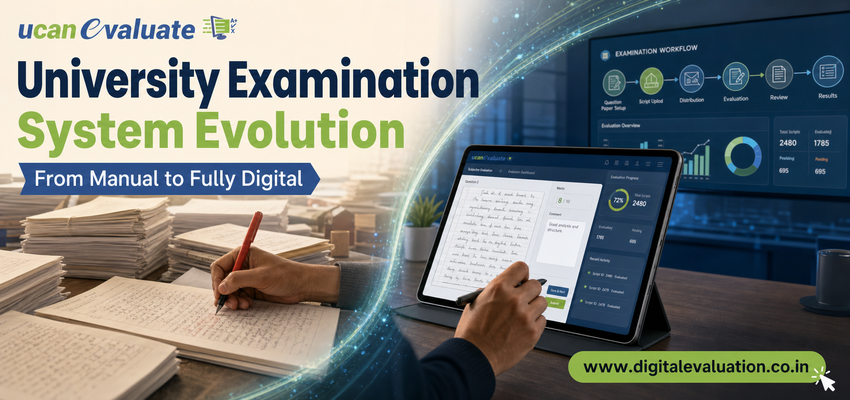
For decades, a typical University Examination System depended on an enormous amount of paperwork.
Question papers were prepared manually. Examination forms moved between departments. Answer booklets travelled physically from examination centres to evaluation locations. Examiners marked scripts using pens, marks were entered manually, totals were checked repeatedly, and result processing involved multiple administrative teams.
The system worked, but increasing examination volumes, geographically distributed campuses, tighter academic schedules and growing expectations for transparency have made purely manual workflows increasingly difficult to manage.
Universities are therefore moving toward a connected digital ecosystem where Pre Examination Processing, Online Assessment, Answer booklet scanning, On-Screen Evaluation, On-Screen Marking, Post Examination Processing and result publication can operate as parts of one coordinated workflow.
The transformation is not simply about replacing paper with computers.
It is about redesigning the complete examination lifecycle.
What Did the Traditional University Examination System Look Like?
Traditional examination management involves several processes that require considerable manual coordination.
A typical examination cycle may include:
• Student and subject data preparation
• Examination scheduling
• Question paper preparation
• Examination centre management
• Printing and distribution
• Collection of physical answer scripts
• Sorting and transportation
• Evaluator allocation
• Manual checking
• Marks entry
• Tabulation
• Moderation
• Result processing
• Result publication
Each stage can work independently, making information movement between departments dependent on files, spreadsheets, physical documents and manual communication.
When thousands of students, hundreds of subjects and multiple examination centres are involved, even a minor operational delay can affect the larger academic calendar.
This is where a modern University Examination System begins to change the equation.
Stage 1: Digitising Pre Examination Processing
Digital transformation begins before a student enters the examination hall.
Modern Pre Examination Processing can centralise important examination activities such as:
• Examination registration
• Student eligibility verification
• Subject mapping
• Examination scheduling
• Admit-card generation
• Centre allocation
• Faculty workflow management
• Question-paper preparation
Instead of different departments maintaining disconnected files, information can move through controlled digital workflows.
This creates a stronger foundation for subsequent stages of Examination Processing.
Question Bank Management Changes How Exam Content Is Created
Question-paper preparation has historically depended heavily on individual faculty members, spreadsheets, documents and email-based coordination.
Modern Question Bank Management changes this approach by creating a central repository where authorised users can create, classify, review and manage examination questions.
Questions can be organised according to parameters such as:
• Subject
• Topic
• Difficulty level
• Question type
• Learning outcome
• Marks
• Academic programme
A structured question bank also helps institutions retain academic knowledge instead of leaving important question repositories distributed across individual computers and departments.
It therefore becomes an important foundation for a scalable University Examination System.
Stage 2: Moving Towards Online Examination Systems
Another major development is the growth of the Online Examination System.
Universities may use online examinations for internal assessments, entrance examinations, recruitment assessments, certification programmes, continuous assessments or selected academic examinations.
An Online Exam Solution can support processes including:
• Candidate authentication
• Question delivery
• Randomised question selection
• Examination timing
• Response capture
• Automated submission
• Objective-question scoring
• Examination monitoring
The broader concept of Online Assessment demonstrates how information technology can be used across different assessment activities, from testing to digital submission and evaluation.
However, digital transformation does not necessarily require universities to eliminate handwritten examinations.
This is an important distinction.
For many institutions, students can continue answering examinations on paper while the evaluation process becomes digital.
That bridge is created through Answer booklet scanning.
Stage 3: Answer Booklet Scanning Connects Paper Exams With Digital Evaluation
After an examination is completed, physical scripts traditionally need to be collected, sorted and transported to evaluators.
With Answer booklet scanning, answer scripts can instead be converted into secure digital files.
A typical workflow may involve:
- Collection – Physical answer booklets are received from examination centres.
- Identification – Booklets are associated with appropriate identifiers or tracking mechanisms.
- Scanning – Pages are converted into readable digital images.
- Quality Checks – Image quality, page sequence and completeness are verified.
- Indexing – Digital scripts are mapped with relevant examination records.
- Upload – Approved scripts are transferred into the Digital Evaluation environment.
Accurate Scanning of Answer Sheets is critical because evaluation quality depends on evaluators receiving complete and readable digital scripts.
Scanning is therefore more than document conversion.
It acts as the gateway between traditional handwritten examinations and modern Digital Evaluation.
Stage 4: From Physical Checking to On-Screen Evaluation
Once answer booklets have been digitised, the next major transformation begins.
Instead of receiving bundles of physical scripts, authorised evaluators can access assigned scripts using an On Screen Evaluation System.
This approach is commonly known as On Screen Evaluation or On-Screen Evaluation.
The evaluator sees the digitised answer booklet through a secure interface and performs the evaluation electronically.
Depending on the system configuration, evaluators may be able to:
• View scanned pages
• Navigate between questions
• Enter marks
• Add annotations
• Flag responses
• Review previously evaluated questions
• Submit completed scripts digitally
The concept also aligns with broader developments in Digital Evaluation, where technology increasingly supports assessment, e-marking and educational workflows.
The important change is not simply that the answer script appears on a monitor.
The entire evaluation workflow becomes more structured and traceable.
Stage 5: On-Screen Marking Brings Greater Control to Evaluation
Traditional marking often depends on handwritten annotations, manual totaling and physical movement of evaluated scripts.
A modern On-Screen Marking System can provide evaluators and examination administrators with a controlled digital environment.
On Screen Marking or On-Screen Marking may support capabilities such as:
• Question-wise mark entry
• Digital annotations
• Automatic totaling
• Evaluator allocation
• Script status tracking
• Review workflows
• Moderation
• Audit trails
• Role-based access
This makes the On Screen Marking System an important component of modern examination administration.
For examination controllers, one of the important advantages is visibility.
Instead of waiting for physical bundles to return before determining evaluation progress, administrators can potentially monitor workflow status digitally.
Stage 6: Digital Evaluation Becomes Part of a Connected Architecture
Universities should not think of a Digital Evaluation System as an isolated application.
A scalable architecture needs to connect multiple stages of the examination process.
A well-planned Digital Evaluation System can connect examination data, digitised answer scripts, evaluator records, marks, review processes and result workflows.
The digital journey may therefore look like:
Question Bank Management → Examination Processing → Answer Booklet Scanning → On-Screen Evaluation → Marks Processing → Result Publication
This connected model reduces dependence on repeated manual data transfer between separate examination activities.
Stage 7: Post Examination Processing Becomes Faster and More Structured
Evaluation is not the final stage of an examination.
Once marking is completed, universities still need to perform extensive Post Examination Processing.
This may include:
• Marks consolidation
• Verification
• Moderation
• Tabulation
• Grace-rule application
• Result calculation
• Approval workflow
• Result publication
• Marksheet generation
• Reporting
In traditional environments, information may need to be transferred from evaluation records into separate result-processing systems.
Digitised workflows can reduce repeated data entry and allow examination information to move more systematically from evaluation to result preparation.
The objective is a connected University Examination System in which data generated at one stage can support the next stage without unnecessary manual intervention.
What Changes When the Examination Lifecycle Becomes Digital?
The biggest difference is not one individual feature.
It is connectivity.
A digitally transformed examination environment can connect processes that were previously handled independently.
1. Better Workflow Visibility
Administrators can gain clearer visibility into examination activities, script allocation, evaluation progress and pending processes.
2. Reduced Physical Movement
Digitisation can reduce the need to repeatedly transport physical answer-booklet bundles between locations.
3. Stronger Traceability
Digital workflows can create records of actions performed during scanning, allocation, evaluation and processing.
4. More Structured Evaluation
An On Screen Evaluation System can provide standardised tools for marking and review.
5. Easier Scaling
A digital environment can be designed to accommodate expanding programmes, campuses, examination centres and evaluation workloads.
6. Faster Data Movement
When different components are integrated, examination information can move from one stage to another without repetitive manual entry.
7. Better Examination Governance
Role-based access, workflow approvals and audit trails can support stronger administrative control.
Manual to Digital Does Not Have to Happen Overnight
One common misconception is that digital transformation means replacing every existing examination process simultaneously.
Universities can adopt digital examination infrastructure gradually.
A phased approach may look like:
- Digitise Question Bank Management
- Automate Pre Examination Processing
- Introduce Answer Booklet Scanning
- Implement On Screen Evaluation
- Connect On Screen Marking with result processing
- Automate Post Examination Processing
- Introduce Online Examination System capabilities where appropriate
This allows institutions to modernise their examination processes according to existing infrastructure, examination volumes and operational priorities.
The Rise of the Connected University Management System
Examinations do not exist independently of other university operations.
Student records, programmes, subjects, academic calendars, faculty information and results are connected to broader institutional processes.
For this reason, a modern University Management System should ideally allow examination workflows to exchange information with other authorised academic systems.
The objective is to avoid creating another isolated technology platform.
The real value appears when information can flow securely across the academic lifecycle.
What Should Universities Look for in a Modern Examination Platform?
Before implementing a new examination technology, universities should evaluate more than individual features.
Key considerations include:
• Scalability for large examination volumes
• Information security
• User-access controls
• Integration capabilities
• Auditability
• Workflow configuration
• Scanning quality controls
• Evaluator usability
• Examination-data management
• Reporting
• Technical support
• Ability to support phased digital transformation
A university may begin with On-Screen Evaluation and later integrate Question Bank Management, Online Assessment, Pre Examination Processing and Post Examination Processing.
The technology should therefore be capable of evolving with institutional requirements.
The Future of the University Examination System
The future of examinations is not simply “online exams.”
It is the development of an interconnected digital ecosystem.
Universities may continue using handwritten examinations where appropriate. Others may adopt fully online assessments. Many are likely to operate hybrid models.
What changes is the infrastructure behind those examinations.
The next-generation University Examination System connects:
Question creation + examination management + answer-script digitisation + On-Screen Marking + evaluation monitoring + result processing + reporting.
As these processes become connected, examination departments can move away from fragmented manual operations toward more manageable, auditable and scalable digital workflows.
Ready to Modernise Your Examination Process?
Transform manual examination workflows into a connected digital ecosystem with Learning Spiral Ltd.