There’s a particular kind of chaos that happens every exam season: examiners hunched over towering stacks of answer booklets, red pens running dry, and a coordinator somewhere frantically trying to track which bundle went to which evaluator. It’s a system that has run universities for decades — and it’s also a system that’s quietly breaking under the weight of larger student numbers, tighter result deadlines, and rising demand for transparency.
On-Screen Evaluation is the answer institutions are increasingly turning to, and understanding what it actually changes — not just in theory, but in day-to-day exam operations — helps explain why the shift is happening so fast.
What Is On-Screen Evaluation, Exactly?
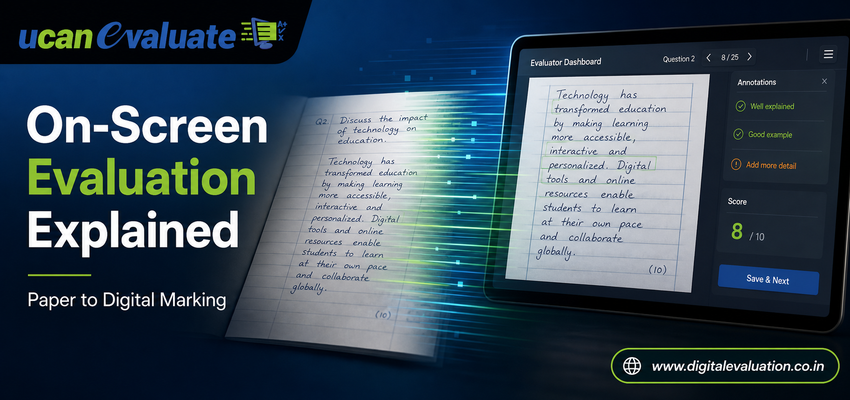
At its core, On-Screen Evaluation means examiners mark digitised copies of student answer scripts on a screen instead of the physical paper. But calling it “marking on a computer” undersells what’s actually happening behind the scenes. A proper On Screen Evaluation System manages the entire journey of a script — from the moment it’s scanned to the moment a verified mark is locked into the university’s records.
How the Process Actually Works
Most universities that adopt this model follow a similar sequence:
- Answer booklet scanning — Physical scripts are digitised through high-speed scanners immediately after the exam, converting every page into a secure, tamper-proof image.
- Barcoding and identity masking — Each script is tagged with a unique code, and student identity is hidden from evaluators to remove any chance of bias.
- Digital distribution for On-Screen Marking — Scripts are algorithmically distributed to evaluators based on subject expertise and workload, regardless of where the evaluator is physically located.
- Marking and moderation — Evaluators score each answer on-screen, with built-in checks that flag inconsistent marking patterns for review before results are finalised.
- Automated compilation — Verified marks flow directly into the result system, cutting out manual tallying entirely.
This is precisely why Scanning of Answer Sheets is considered the foundation of the entire process — a related technique long used in structured data capture is what technologists call optical mark recognition, which laid the early groundwork for how machines interpret human-marked responses at scale.
Why Universities Are Making the Switch
The appeal of moving away from paper isn’t just about looking modern. A few concrete problems get solved at once:
- Faster results — Digital workflows can cut evaluation timelines from weeks to days.
- Reduced bias — Masked identities mean marks reflect the answer, not who wrote it.
- No lost booklets — Once scanned, a script exists permanently as a digital record.
- Location-independent evaluation — Examiners aren’t limited to whoever is available on campus.
- Full auditability — Every action on every script is logged, which matters enormously during revaluation disputes.
On-Screen Marking System vs Traditional Marking
The difference isn’t just digital versus physical — it’s structured versus informal. A traditional process depends heavily on individual coordination: physically sorting booklets, tracking who has which bundle, and manually re-checking totals. An On-Screen Marking System replaces all of that with rules the software enforces automatically — deadlines, double-checks, and moderation thresholds that don’t rely on someone remembering to follow up.
This structured approach fits into the wider practice of electronic assessment, where technology doesn’t just digitise a task but actually improves how consistently that task is performed.
Where This Fits Into the Bigger Picture
On-Screen Evaluation rarely works in isolation — it’s one stage inside a much larger exam lifecycle:
- Pre Examination Processing — everything from paper-setting to hall ticket generation happens before evaluation even starts. A well-run Pre Examination Processing stage means scripts arrive ready for a smooth digital workflow, without last-minute data mismatches.
- Digital Evaluation System — the Digital Evaluation System is the umbrella that connects scanning, marking, and moderation into one continuous, trackable pipeline.
- Answer booklet scanning — as covered above, the Answer booklet scanning step is what makes everything downstream possible.
- University Examination System — evaluation is just one module inside a full University Examination System, which also handles scheduling, result declaration, and compliance reporting.
The Real Question for Universities in 2026
The question isn’t really “should we digitise evaluation” anymore — most universities already agree it’s inevitable. The real question is timing: do you make the shift now, on your own terms, with a proper Online Exam Solution and trained staff, or do you get forced into a rushed transition later when manual processes finally collapse under student volume?
An institution that adopts On-Screen Evaluation, backed by solid Question Bank Management and Post Examination Processing, isn’t just modernising a workflow — it’s protecting its academic reputation from the kind of errors that paper-based systems eventually, inevitably produce.
Moving from paper to pixels changes more than just where a red pen lands. It changes how fast students get results, how fairly those results are calculated, and how confidently a university can defend its evaluation process when questioned. For institutions weighing the shift in 2026, the technology, the vendors, and the proof of results are already there — the only remaining variable is when to start.