Most exam disasters don’t happen during evaluation — they happen weeks before, quietly, while nobody is watching. A repeated question slips into two consecutive papers. A difficulty level is skewed because the same three faculty members always set the toughest sections. A paper leaks because it sat in someone’s inbox for a week before printing. By the time these mistakes surface, they’re no longer small errors — they’re headlines.
This is exactly why Pre Examination Processing deserves as much attention as the exam itself. It’s the invisible groundwork — paper setting, question selection, moderation, scheduling, and security — that decides whether exam day runs smoothly or turns into a crisis meeting. And increasingly, the difference between the two comes down to one thing: whether a university is still setting papers manually, or using proper Question Bank Management tools to do it.
Below are six practical strategies universities can adopt to strengthen their Examination Processing pipeline, long before the first student walks into the hall.
1. Build a Centralised, Tagged Question Repository
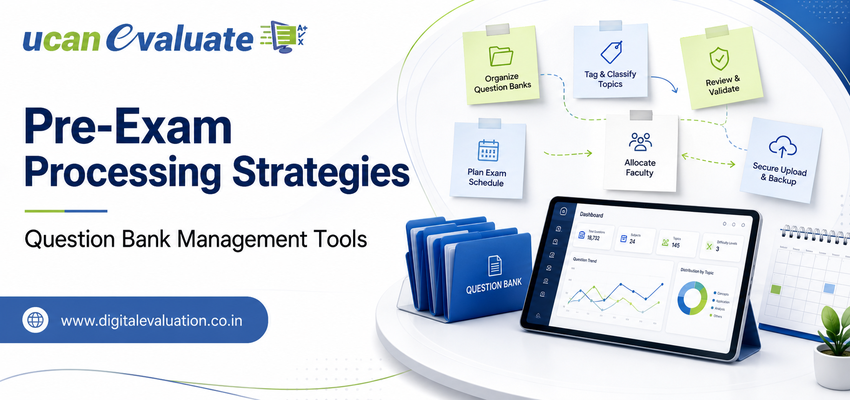
The single biggest upgrade any exam cell can make is moving away from scattered question papers stored in individual faculty folders. A centralised Digital Evaluation ecosystem starts with a searchable repository where every question is tagged by subject, topic, difficulty level, and Bloom’s taxonomy category. This is essentially what testing researchers call an item bank — a structured question repository designed to keep test content secure, reusable, and statistically tracked. Once questions live in one place instead of a hundred laptops, duplication and repetition problems disappear almost overnight.
2. Automate Paper Generation with Rule-Based Selection
Manual paper-setting relies on one or two faculty members remembering “roughly” how many easy, medium, and hard questions to include. A rule-based Online Exam Solution removes the guesswork by letting administrators define selection criteria — topic weightage, difficulty distribution, question type ratio — and generating a compliant paper automatically. This doesn’t just save hours; it guarantees every paper meets the same academic standard, every single time.
3. Randomise Papers to Prevent Malpractice
Question banks aren’t just about organisation — they’re a malpractice deterrent. With a large enough pool of tagged questions, a proper Question Bank Management system can generate multiple randomised versions of the same paper for different exam halls, making it far harder for students to share answers across rooms. This single strategy alone has been shown to meaningfully reduce copying incidents in large-scale examinations.
4. Route Papers Through a Structured Moderation Workflow
A question paper shouldn’t go from one professor’s laptop straight to the printer. Strong Pre Examination Processing includes a moderation layer — a second (and sometimes third) reviewer checking for ambiguous wording, incorrect answer keys, or syllabus mismatch — all tracked digitally with timestamps and approval logs. This isn’t extra bureaucracy; it’s the same quality-control principle behind broader educational assessment practices worldwide, where reliability is treated as seriously as the content itself.
5. Secure the Paper Until the Last Possible Moment
Every leaked paper story starts the same way: a document sitting somewhere it shouldn’t, for longer than it should. Encrypted storage, role-based access, and time-locked release (where papers only unlock at the printing centre minutes before distribution) are now standard features of a mature University Examination System. If your current process still involves emailing a Word document to a print shop, this is the single most urgent fix on this list.
6. Connect Pre-Exam Data to Post-Exam Evaluation
The final strategy is often overlooked: pre-examination data shouldn’t sit in isolation. When question metadata, difficulty ratings, and paper structure feed directly into the evaluation stage, it becomes far easier to run On-Screen Evaluation with pre-mapped answer keys and scheme-based marking. A well-integrated Online Examination System treats pre-exam and post-exam processing as one continuous pipeline, not two disconnected departments that happen to share the same students.
Why This Matters More in 2026
Universities are no longer being compared only on faculty reputation or campus infrastructure — they’re being compared on how fast, fair, and leak-proof their examination process is. A single viral paper-leak story can undo years of brand-building in a single admission season. Strong Post Examination Processing gets a lot of attention in these conversations, but none of it matters if the paper itself was compromised before the exam even began.
Getting the pre-examination stage right isn’t glamorous work. It doesn’t make headlines when done correctly — and that’s exactly the point. A university that never has to explain a paper leak, a repeated question, or an unfair difficulty spike is a university that’s already won the trust battle before results are even out.
Where to Start
If your institution is still juggling question papers across USB drives, WhatsApp groups, and individual faculty inboxes, the fix doesn’t have to be a massive overhaul. Most universities start with just one strategy — usually a centralised Question Bank Management system — and build outward from there as confidence (and question volume) grows.
The universities that get this right in 2026 won’t be the ones with the most expensive infrastructure. They’ll be the ones who treated pre-examination processing as seriously as the exam day itself.