Why Accurate Scanning Matters in Digital Evaluation
Examination authorities across the country are moving away from manual, paper-based checking toward digital systems that promise speed, accuracy, and transparency. But the entire success of a Digital Evaluation System hinges on one critical first step: scanning of answer sheets.
Poor scan quality can lead to misaligned answers, illegible handwriting capture, or missing pages — all of which compromise the integrity of On-Screen Marking. Getting this step right is non-negotiable for institutions serious about digitization.
Common Challenges in Answer Booklet Scanning
Universities transitioning to digital assessment often face a few recurring hurdles:
- Volume management – Handling thousands of answer booklets during peak exam seasons without delays
- Image quality inconsistencies – Faded ink, torn pages, or uneven lighting affecting scan clarity
- Barcode and roll number misreads – Errors in student identification during Post Examination Processing
- Data security concerns – Ensuring scanned data remains tamper-proof and confidential
- Integration issues – Syncing scanned data smoothly with an Online Examination System or evaluation dashboard
Addressing these challenges early prevents downstream errors that can affect result accuracy and institutional credibility.
Best Practices for Accurate Answer Sheet Scanning
1. Use High-Resolution, Purpose-Built Scanners
Standard office scanners aren’t built for academic volume or precision. Institutions should invest in high-speed, education-grade scanners designed specifically for Answer Booklet Scanning, ensuring crisp, readable images every time.
2. Standardize Answer Booklet Formats
Uniform booklet design — consistent margins, barcode placement, and page numbering — significantly reduces scanning errors and speeds up automated sorting during Examination Processing.
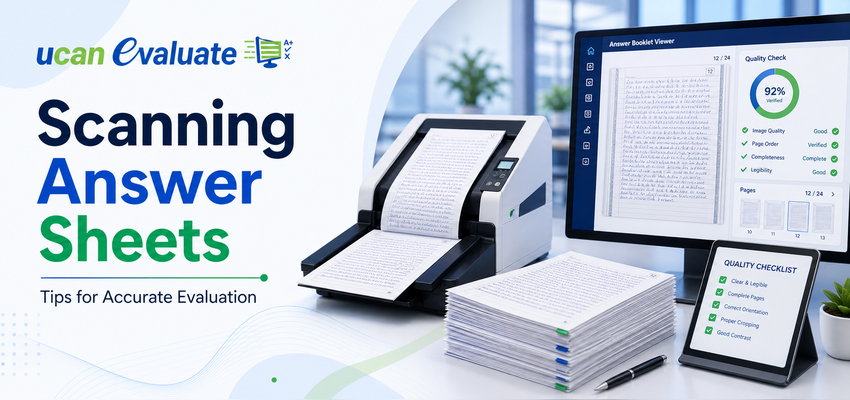
3. Implement Automated Quality Checks
Modern scanning software should automatically flag blank pages, skewed images, or unreadable barcodes before evaluators begin marking, minimizing manual rework.
4. Secure the Scanning Environment
Physical and digital security protocols — restricted access, encrypted storage, and audit trails — are essential to prevent tampering during scanning and subsequent On Screen Evaluation.
5. Train Staff on Digital Workflows
Even the best technology underperforms without trained personnel. Regular training on scanning tools and troubleshooting ensures consistent output quality.
Benefits of Accurate Scanning for Universities
When scanning is done right, institutions unlock significant advantages:
- Faster turnaround for results through streamlined Post Examination Processing
- Reduced human error compared to manual evaluation
- Enhanced transparency with digital audit trails
- Easier integration with a broader University Examination System
- Scalability during high-volume exam cycles
Solutions like those offered by Learning Spiral are designed to simplify this entire process — from scanning to final result declaration — helping universities modernize without disrupting existing workflows.
The Future of Answer Sheet Scanning and Evaluation
The next wave of innovation in this space includes AI-assisted handwriting recognition, real-time quality validation, and deeper integration with Question Bank Management and analytics platforms. As institutions adopt more comprehensive University Management System frameworks, scanning technology will continue evolving toward near-zero error rates and instant processing.
Universities that invest in robust scanning infrastructure today are positioning themselves for a more efficient, transparent, and student-friendly evaluation ecosystem tomorrow.
Ready to Modernize Your Examination Process?
Accurate scanning is just the beginning. Explore how Learning Spiral’s complete suite of exam automation solutions — from pre-examination processing to on-screen marking — can transform your institution’s assessment workflow.
Request a free demo today and see how seamless digital evaluation can truly be.