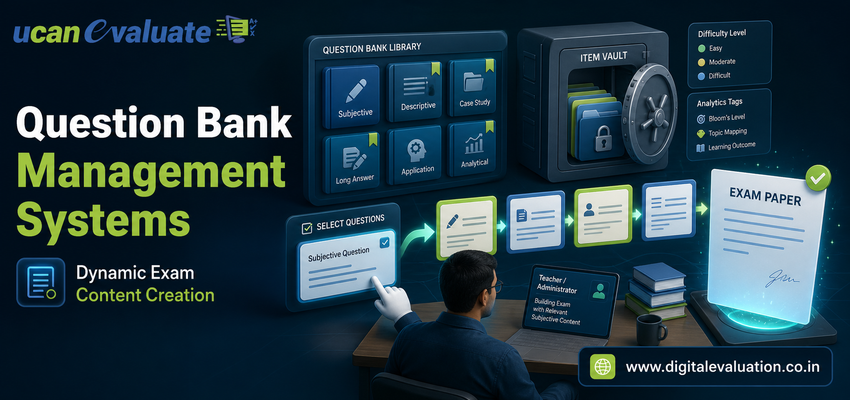
Creating a university examination paper should not begin with faculty searching through old Word files, spreadsheets, email attachments or folders of previously used questions.
As universities manage more programmes, subjects, semesters and examination patterns, question-paper creation becomes a complex academic workflow. Questions must be relevant to the syllabus, balanced by difficulty, aligned with learning outcomes, reviewed by authorised faculty and protected until examination day.
This is where a modern Question Bank Management System can transform examination preparation.
Instead of maintaining disconnected collections of questions, universities can create a structured digital repository that supports question authoring, classification, moderation, approval and dynamic exam-content creation.
More importantly, Question Bank Management does not need to operate as an isolated tool. It can become the starting point of a connected University Examination System that continues through examination delivery, Answer booklet scanning, On Screen Evaluation, Digital Evaluation and Post Examination Processing.
What This Article Covers
• Why universities need structured Question Bank Management
• How dynamic question-paper creation works
• Nine ways a Question Bank Management System can improve examination preparation
• How Question Bank Management connects with an Online Examination System and Digital Evaluation
• Why faculty judgment remains essential even when automation and AI are introduced
• Common mistakes universities should avoid when building digital question repositories
• What institutions should evaluate before selecting a Question Bank Management solution
What Is Question Bank Management?
Question Bank Management is the structured process of creating, storing, classifying, reviewing, approving and reusing examination questions through a central digital repository.
Rather than keeping questions in separate files, authorised academic teams can organise them according to parameters such as programme, course, semester, subject, unit, topic, question type, marks, difficulty level and learning objective.
A well-designed system therefore becomes much more than a database.
It becomes an academic content-management environment that helps examination teams answer an important question:
Which questions should appear in this examination, and why?
When the repository is properly structured, paper setters can search and select relevant questions more efficiently, while examination administrators can apply defined rules for paper creation, review and approval.
Why Static Question-Paper Creation Is Becoming Difficult
A university may conduct hundreds or even thousands of papers across an academic year.
When question creation depends heavily on emails, documents and manual coordination, several challenges begin to appear.
• The same question may be repeated too frequently.
• Different departments may use inconsistent difficulty standards.
• Review and approval status may become difficult to track.
• Old or outdated questions may remain in circulation.
• Paper setters may spend significant time searching for suitable content.
• Sensitive question papers may pass through unnecessary hands.
• Creating alternate paper sets can become time-consuming.
• Mapping questions against course outcomes may require additional manual work.
A structured Question Bank Management System addresses these issues by treating examination content as a controlled academic asset rather than a collection of individual files.
1. Build One Central Repository for Examination Questions
The first advantage of Question Bank Management is centralisation.
Instead of questions being distributed across faculty laptops, department folders and email inboxes, institutions can bring authorised examination content into one controlled repository.
Questions can then be organised according to the university’s academic structure.
For example, an engineering university might classify a question according to programme, semester, subject, unit, learning outcome, difficulty level, marks and question type.
A commerce department may use a different structure.
The system should be flexible enough to reflect the institution’s actual academic model.
Centralisation also creates a stronger foundation for Pre Examination Processing because question preparation becomes part of a structured examination workflow rather than an independent manual activity.
2. Use Metadata to Find the Right Question Faster
A large question bank has limited value if faculty cannot quickly find the right content.
That is why metadata and tagging are critical.
Each question can be associated with information such as:
- Subject and course
- Unit or chapter
- Difficulty level
- Marks or weightage
- Question type
- Learning outcome
- Programme and semester
- Usage history
- Approval status
Once questions are classified consistently, paper setters no longer need to manually search through hundreds of files.
They can work with a structured pool of relevant questions and focus more attention on academic quality.
This approach also supports stronger educational assessment design because the examination can be built around planned learning objectives rather than whatever questions happen to be easily available. The broader principle of educational assessment is closely connected with using evidence of student performance to understand learning and achievement.
3. Create Dynamic Question Papers Using Defined Rules
One of the strongest uses of a Question Bank Management System is dynamic exam-content creation.
Rather than creating every paper from scratch, examination teams can define a blueprint.
For example, a 100-mark paper may require:
• 20 marks from Unit 1
• 20 marks from Unit 2
• 30 marks from Unit 3
• 30 marks from Unit 4
Within that structure, the institution may also define how many questions should be easy, moderate or difficult.
Paper-generation rules can further specify question type, marks, learning outcomes or other academic parameters.
This enables institutions to create papers that are more balanced and structured while still keeping authorised faculty in control of final review and approval.
Dynamic generation can also support multiple paper sets when institutional policy requires them.
The objective is not randomisation for its own sake.
The objective is controlled variation within an approved academic blueprint.
4. Build Review and Moderation Into Question Creation
A question should not move directly from an author’s screen into the final examination.
Academic review remains essential.
A structured workflow might look like this:
Question Authoring → Academic Review → Moderation → Approval → Question Bank → Paper Creation → Final Approval
Each stage can have different permissions.
The faculty member who creates a question may not necessarily be the same person who approves it for examination use.
A moderator may review wording, difficulty, curriculum alignment, duplication and marks allocation before approval.
This makes Question Bank Management particularly useful for universities operating across several departments or affiliated colleges because it creates a common process without removing academic responsibility.
5. Balance Difficulty Instead of Guessing It
A good examination should appropriately differentiate between different levels of student understanding.
If a paper contains too many easy questions, it may not adequately evaluate learning.
If it contains too many difficult questions, results may reflect paper design rather than actual student capability.
Question Bank Management helps institutions define and organise questions according to difficulty.
Exam blueprints can then specify the desired balance between easy, moderate and difficult questions.
Over time, institutions can also review how particular questions perform and refine their categorisation where appropriate.
The result is a more systematic approach to exam-content creation instead of depending entirely on last-minute manual selection.
6. Make Question Reuse Controlled, Not Repetitive
Reusing a good question is not necessarily a problem.
Repeating the same questions too frequently is.
A digital question repository can maintain information about when a question was created, reviewed, approved, modified or previously used.
That visibility allows examination teams to make more informed decisions.
For example, frequently used questions can be temporarily excluded from upcoming papers, while questions that have become academically outdated can be revised or archived.
This turns the question bank into a continuously managed academic resource rather than an ever-growing storage folder.
Version control is equally important.
When a question is updated, the system should make it possible to distinguish the current approved version from previous versions so that outdated content does not accidentally return to circulation.
7. Protect Confidential Exam Content Through Controlled Access
Question papers are among the most sensitive assets in an examination process.
A digital repository therefore requires clear access controls.
Instead of allowing every user to see the entire question pool, permissions can be aligned with institutional responsibilities.
For example, a question author may be able to create and edit assigned content, while a moderator can review it and an examination administrator controls final paper generation.
Access management can help limit unnecessary exposure to sensitive examination material.
Security should continue beyond question creation as well.
The complete chain may look like:
Question Bank → Paper Generation → Approval → Secure Distribution → Examination → Evaluation → Result Processing
This is one reason Question Bank Management works best when it is connected with a broader Online Examination System rather than being treated as a standalone repository.
8. Support Different Question Types and Assessment Models
Modern university assessment is no longer limited to one question format.
Depending on the discipline and examination model, institutions may need to manage:
• Multiple-choice questions
• Short-answer questions
• Descriptive questions
• Numerical questions
• Case-based questions
• Scenario-based questions
• Diagram-based questions
• Subject-specific question formats
The question bank should retain the relevant metadata required for each type.
This becomes particularly useful when universities combine traditional written examinations with Online Assessment.
Some programmes may continue with handwritten descriptive examinations, while others may use computer-based assessments.
Question Bank Management can provide a common content foundation for both models.
9. Connect Question Creation With Digital Evaluation
Question Bank Management belongs at the beginning of the examination lifecycle, but its value becomes greater when downstream processes are connected.
Consider a paper-based university examination.
The workflow may look like this:
Question Bank Management → Question Paper → Examination → Answer booklet scanning → On Screen Evaluation → Marks Processing → Results
For a computer-based examination, the workflow may instead be:
Question Bank Management → Online Examination System → Digital Response Capture → Digital Evaluation → Results
Both workflows ultimately depend on well-structured examination content.
A connected Digital Evaluation environment can then support evaluators after the examination by bringing scripts or responses into controlled marking workflows.
This is where Question Bank Management, Scanning of Answer Sheets, On Screen Marking and Post Examination Processing stop being separate technologies and begin functioning as parts of one examination ecosystem.
From Question Bank to On-Screen Evaluation: One Connected Journey
Universities often digitise examination processes in stages.
One institution may begin with Question Bank Management.
Another may start with an On Screen Evaluation System.
A third may first adopt an Online Exam Solution.
The long-term opportunity is to connect these individual processes.
For handwritten examinations, answer booklets can undergo Scanning of Answer Sheets and then be securely allocated to evaluators through an On-Screen Evaluation or On Screen Marking System.
For online examinations, student responses can flow directly into a Digital Evaluation System.
Once marks are finalised, they can become part of Post Examination Processing for result compilation, moderation, revaluation and publication.
A modern University Examination System can therefore connect:
- Pre Examination Processing
- Question Bank Management
- Online Examination System
- Online Assessment
- Answer booklet scanning
- On Screen Evaluation
- On-Screen Marking
- Digital Evaluation
- Post Examination Processing
The objective is not simply to digitise individual activities.
It is to create continuity throughout Examination Processing.
Automation Should Support Faculty Judgment, Not Replace It
Dynamic paper creation and AI-assisted workflows can reduce repetitive work, but academic decisions still require faculty oversight.
Technology can help classify questions, identify content, organise repositories or generate structured combinations based on defined rules.
However, subject experts still need to determine whether a question is academically accurate, appropriately worded and suitable for the intended learning outcome.
The wider conversation around digital education makes a similar point: as AI and digital tools become more capable, the role of educators increasingly centres on judgment, context, mentoring and knowing when technology strengthens learning rather than replacing necessary academic thinking.
For Question Bank Management, the principle should therefore be straightforward:
Automate repetitive administration. Preserve academic control.
Common Question Bank Management Mistakes Universities Should Avoid
Even a powerful Question Bank Management System will underperform if the underlying academic process is poorly designed.
Universities should watch for these common problems.
1. Creating Thousands of Questions Without a Taxonomy
Volume alone does not create a useful question bank.
Questions must be consistently classified so that authorised users can find and use them.
2. Ignoring Review Status
Draft, reviewed, approved, rejected and archived questions should not all appear as equally usable content.
Clear status controls reduce confusion.
3. Using Difficulty Labels Without Defined Criteria
If one faculty member’s “easy” is another faculty member’s “difficult,” paper generation will remain inconsistent.
Institutions should establish practical guidance for question classification.
4. Allowing Uncontrolled Duplication
Duplicate questions increase repository size without increasing academic value.
Periodic review and cleanup are essential.
5. Treating Security as Only a Login Feature
Question confidentiality depends on permissions, workflow, access visibility and secure handling throughout paper creation and distribution.
6. Disconnecting the Question Bank From Examination Processing
If questions are created digitally but every later process still requires manual re-entry, much of the efficiency is lost.
Integration should be considered early.
What Should Universities Look for in a Question Bank Management System?
Before selecting a solution, examination teams should evaluate both academic and operational requirements.
A practical checklist includes:
- Centralised repository: Can questions across departments and programmes be securely organised?
- Flexible categorisation: Can questions be mapped by subject, topic, difficulty, marks and learning outcome?
- Multiple question types: Does the system support the formats your institution actually uses?
- Role-based workflows: Can authors, reviewers, moderators and examination administrators have different permissions?
- Dynamic paper creation: Can papers be generated according to approved academic rules?
- Version management: Can users identify the current approved version of a question?
- Usage tracking: Can examination teams understand when questions have previously been used?
- Security controls: Is sensitive content protected throughout the workflow?
- Integration: Can Question Bank Management connect with Pre Examination Processing, an Online Examination System, On-Screen Evaluation, Digital Evaluation and result workflows?
- Scalability: Can the platform support increasing programmes, papers, subjects and examination volumes without creating administrative complexity?
The right solution should fit the institution’s examination model rather than forcing the institution to redesign academic processes around rigid software.
How Learning Spiral Ltd. Supports a Connected Examination Ecosystem
Learning Spiral Ltd. works with universities, examination bodies and educational institutions to digitise and connect examination processes.
The goal is not simply to introduce another application into the examination department.
It is to help institutions create more structured workflows across Question Bank Management, Pre Examination Processing, Online Examination System, Online Assessment, Answer booklet scanning, On Screen Evaluation, On-Screen Marking, Digital Evaluation and Post Examination Processing.
When these processes work together, examination teams can reduce repetitive coordination and build greater control across the complete examination lifecycle.
For universities already using a University Management System, the next step should be to examine how academic, examination and evaluation workflows can exchange information instead of operating as isolated systems.
Final Thoughts: The Exam Paper Should Be Dynamic, but the Process Must Stay Controlled
Question Bank Management is changing the way universities approach examination-content creation.
Instead of beginning every examination cycle with disconnected files and manual question searches, institutions can build an organised academic repository that supports structured authoring, review, moderation and dynamic paper generation.
The greatest value, however, comes from connection.
A question created during Pre Examination Processing can become part of an Online Assessment or printed examination, move into an On Screen Evaluation System or Digital Evaluation System, and ultimately contribute to Post Examination Processing and final results.
That creates a far more complete view of examination technology.
The future of exam-content creation is not simply generating questions faster. It is putting the right question into the right assessment through a secure, measurable and academically controlled process.
FAQs
1. What is Question Bank Management?
Question Bank Management is the digital process of creating, classifying, reviewing, approving, storing and reusing examination questions through a structured central repository.
2. How does Question Bank Management help with question-paper creation?
It allows examination teams to organise approved questions according to parameters such as subject, unit, marks, difficulty and learning outcomes. Papers can then be prepared using defined academic rules instead of searching through disconnected files.
3. Can Question Bank Management work with an Online Examination System?
Yes. A structured question bank can provide approved content for an Online Examination System or Online Assessment platform while also supporting conventional paper examinations.
4. How does Question Bank Management connect with On Screen Evaluation?
Question Bank Management operates before the examination, while On Screen Evaluation and On Screen Marking operate mainly after responses are captured. Connecting both within the University Examination System creates a more continuous examination workflow.
5. Does a Question Bank Management System replace faculty paper setters?
No. Technology can support categorisation, workflow and dynamic paper generation, but academic experts should continue to control question quality, relevance, moderation and final approval.
Ready to modernise your examination workflows?
Connect with Learning Spiral Ltd. to explore Question Bank Management, Online Examination Systems, Answer Booklet Scanning, On Screen Evaluation, Digital Evaluation and end-to-end Examination Processing solutions for your institution.