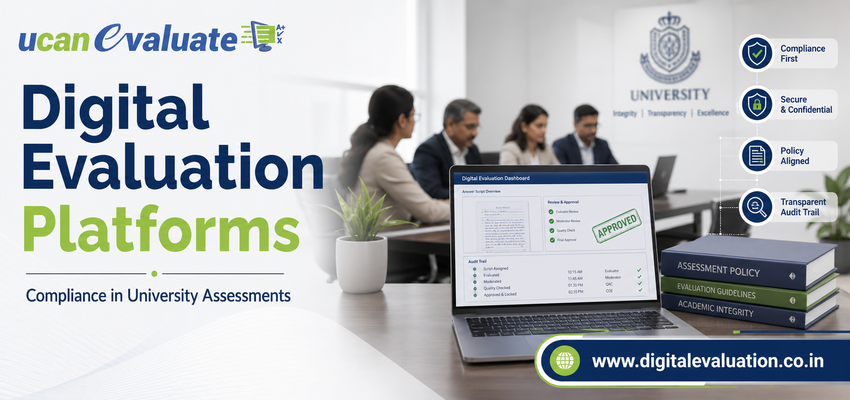
For a university, examination compliance is not limited to conducting an exam on schedule.
It extends across the complete assessment journey—from question preparation and candidate records to answer-script handling, evaluator allocation, marking, moderation, result processing, re-evaluation and audit readiness.
When these activities depend heavily on physical answer booklets, spreadsheets, emails and disconnected systems, proving that every stage followed an approved process can become difficult.
This is where a modern Digital Evaluation System becomes strategically important.
A digital platform does more than move answer sheets from paper to a screen. When designed and implemented correctly, it can help universities create controlled workflows, maintain traceable records, restrict access, standardise evaluation activities and strengthen visibility across the assessment lifecycle.
The objective is not merely faster evaluation.
It is secure, accountable, consistent and compliance-ready examination processing.
Why Compliance Matters in University Assessments
Universities manage some of their most sensitive academic records during examination cycles.
Student identities, answer scripts, evaluator details, marks, moderation decisions, re-evaluation records and final results all need to move through controlled processes.
Regulatory expectations and institutional rules may vary according to the university, programme, examination type and mode of delivery. What remains consistent is the need for examinations to be managed through documented, credible and transparent processes.
A university therefore needs to answer questions such as:
• Who accessed a particular answer script?
• Which evaluator assessed it?
• When was the evaluation completed?
• Were all questions marked?
• Was the script moderated or re-evaluated?
• Were marks changed after the initial evaluation?
• Who approved those changes?
• Can the institution reconstruct the examination workflow later if required?
A well-designed Digital Evaluation System can help make these questions easier to answer because assessment activity takes place within a structured digital environment.
1. Build Traceability Into Every Evaluation Step
One of the biggest advantages of Digital Evaluation is traceability.
In traditional evaluation, physical scripts may move between examination departments, distribution centres, evaluators and verification teams. Maintaining a complete history of every movement can require substantial manual documentation.
With On Screen Evaluation, important actions can instead be associated with authorised users and system workflows.
Depending on platform configuration, institutions can maintain records relating to script allocation, evaluator activity, marks entry, moderation, completion status and approval workflows.
This creates a clearer operational trail.
For a Controller of Examinations, that visibility is valuable not only during the examination cycle but also when responding to internal reviews, re-evaluation requests, academic disputes or process audits.
Compliance becomes easier to support when the institution can demonstrate what happened, when it happened and through which authorised workflow.
2. Protect Student Identity During Evaluation
Fair assessment requires evaluators to focus on academic responses rather than unnecessary candidate information.
A Digital Evaluation workflow can support anonymised or masked answer scripts so that evaluators receive the information required for marking without automatically seeing all student-identifying details.
This can help separate candidate identity from evaluation activity and create a more structured marking environment.
Within an On Screen Marking System, script allocation can also be controlled centrally rather than depending entirely on the physical movement of booklets.
For universities handling thousands or lakhs of scripts, this provides a scalable way to manage evaluation while maintaining stronger process controls.
3. Make Answer Booklet Scanning Part of Compliance
Digital evaluation begins long before an evaluator starts marking.
The quality and integrity of the digital answer script depend on the scanning process.
A missing page, incorrect sequence, unreadable image, duplicate scan or incorrectly mapped supplementary sheet can create an evaluation problem even when the marking software itself works perfectly.
That is why Answer Booklet Scanning should be treated as a controlled examination process rather than ordinary document scanning.
A strong scanning workflow should help verify:
- Completeness: Every expected page is captured.
- Readability: Handwriting, diagrams, calculations and supplementary responses remain clearly visible.
- Correct sequencing: Pages are presented to the evaluator in the appropriate order.
- Script mapping: The digital record remains associated with the correct examination record.
- Exception handling: Damaged, missing or irregular scripts are identified before evaluation.
When scanning quality is controlled at the beginning, universities reduce the risk of errors propagating into On Screen Evaluation and result processing.
4. Control Who Can Access Examination Data
Examination information should not be accessible simply because someone has access to the university network or a shared computer.
A compliance-ready Digital Evaluation platform should support clearly defined user roles.
An evaluator may need access to allocated scripts and marking tools.
A head examiner may require moderation functionality.
A Controller of Examinations may need progress dashboards and administrative controls.
Technical support personnel may require system-level access without needing unrestricted visibility into confidential academic data.
Separating these permissions helps universities apply the principle that users should receive the access necessary for their responsibilities—not unrestricted access to the entire examination environment.
Strong information security practices are especially important as universities increasingly depend on cloud infrastructure, connected applications and digital academic records.
The broader technology environment also deserves attention. Recent discussions around AI and cybersecurity risks show why institutions need visibility into the digital tools being used and the information flowing through them.
For examination departments, digital transformation and data governance should therefore progress together.
5. Standardise On-Screen Marking
Compliance is difficult to demonstrate when different evaluators follow completely different processes.
An On Screen Marking environment can help universities introduce greater structure into evaluation.
Depending on institutional requirements, workflows may incorporate approved marking schemes, question-wise marks, annotations, validation rules, evaluator allocation, moderation and completion checks.
The purpose is not to remove academic judgment.
It is to make the surrounding process more consistent.
For example, a system can help prevent an evaluator from accidentally completing a script while a required question remains unmarked.
It can also create visibility into whether an evaluator has completed assigned scripts and whether particular cases require review.
This converts evaluation from a largely invisible activity into a measurable workflow.
6. Strengthen Moderation and Re-Evaluation Workflows
High-stakes university assessments often require more than first-level evaluation.
There may be moderation, scrutiny, double evaluation, rechecking or re-evaluation depending on institutional rules.
When these activities occur through physical scripts and manual registers, tracking each stage can become complex.
A digital workflow can help institutions route scripts through approved review stages while preserving the relationship between the original evaluation and subsequent action.
That distinction is important.
If marks change, the institution should ideally be able to understand whether the change resulted from moderation, re-evaluation, correction of a data-entry issue or another approved academic process.
A well-structured On-Screen Marking System therefore supports not only digital marking but also the governance surrounding marks.
7. Connect Evaluation With the Complete University Examination System
Digital evaluation should not operate as an isolated island.
The real value becomes clearer when it is connected with the wider University Examination System.
A university examination lifecycle may include:
- Pre Examination Processing for registration, subject mapping, scheduling and examination preparation.
- Question Bank Management for structured question creation and academic controls.
- Examination delivery through physical or digital modes.
- Scanning of Answer Sheets for handwritten examinations.
- On Screen Evaluation for digital script assessment.
- On-Screen Marking and moderation.
- Marks verification and approval.
- Post Examination Processing for final academic processing.
- Result generation and publication.
When these activities are connected, duplicate data entry can be reduced and administrators gain better visibility into the status of the examination cycle.
This is especially important for universities managing large student populations, multiple programmes and several examination sessions each year.
8. Improve Control Over the Scanning of Answer Sheets
A university may scan lakhs of pages during a major examination cycle.
At this scale, even a small error rate can create significant downstream work.
A controlled Scanning of Answer Sheets workflow should therefore include defined quality checks before scripts become available to evaluators.
Universities can establish procedures to identify:
• Missing pages
• Duplicate pages
• Cropped responses
• Incorrect page orientation
• Poor image quality
• Unreadable writing caused by scanning problems
• Incorrect script associations
• Missing supplementary sheets
• Unexpected page counts
These controls help protect the integrity of the digital script.
They also create a cleaner separation between scanning exceptions and evaluation exceptions, making operational troubleshooting easier.
9. Turn Audit Readiness Into an Everyday Process
Universities should not begin collecting examination evidence only when somebody asks for it.
A better approach is to make traceability part of normal examination operations.
Digital Evaluation platforms can support this by capturing structured information while work is being performed.
Instead of reconstructing activity afterwards from paper files and emails, authorised administrators can work from system-generated records and reports.
Useful operational information may include:
• Number of scripts scanned
• Number allocated for evaluation
• Evaluator-wise progress
• Pending scripts
• Completed evaluations
• Moderation status
• Exception cases
• Marks-processing progress
• Re-evaluation status
• Result-processing status
This information can support internal control, management review and operational transparency.
Most importantly, auditability should not be understood as surveillance of faculty.
It is about establishing a dependable record of a high-stakes academic process.
Digital Evaluation and Online Assessment: Know the Difference
Digital Evaluation and Online Assessment are related but not identical.
An Online Examination System may allow students to take an assessment directly through a digital platform.
Digital Evaluation may also apply to traditional handwritten examinations.
In such a model, students continue writing answers on physical booklets. Those scripts are then digitised and distributed electronically to authorised evaluators.
Universities therefore do not necessarily need to replace every handwritten examination to benefit from digital evaluation.
A hybrid examination environment can connect traditional written assessments with modern On-Screen Evaluation and Post Examination Processing.
Compliance Requires More Than Software
Technology can provide controls, but software alone cannot make an institution compliant.
Universities still need clearly documented academic rules, authorised users, defined responsibilities, appropriate data practices, evaluator training, escalation procedures and governance.
A useful implementation should therefore align the technology with the institution’s approved examination framework.
Before deployment, universities should define:
- Who can view student and script data?
- Who can allocate answer scripts?
- Who can modify marks and under what circumstances?
- What moderation rules apply?
- How are exceptions escalated?
- What records need to be retained?
- How is re-evaluation managed?
- Who authorises final result processing?
- How are system and examination records reviewed?
- Which institutional, statutory and regulatory requirements apply to the specific examination?
Once those rules are clear, technology can help enforce and document them consistently.
How Learning Spiral Ltd. Supports Digital Evaluation
Learning Spiral Ltd. supports universities, education boards and examination authorities with technology-led examination workflows spanning Digital Evaluation, On Screen Evaluation, On-Screen Marking, Answer Booklet Scanning, Question Bank Management, University Examination System, Online Examination System, Pre Examination Processing and Post Examination Processing.
The objective is to connect the stages of the examination lifecycle instead of forcing institutions to manage each activity through isolated tools.
For Digital Evaluation, structured workflows can support answer-script digitisation, allocation, controlled evaluator access, On Screen Marking, progress monitoring, moderation, marks processing and result-related activities.
This approach helps examination teams move beyond simply replacing red pens with computer screens.
It creates a more measurable and connected assessment environment.
What Universities Should Check Before Selecting a Digital Evaluation Platform
Before implementing an On Screen Evaluation System, universities should evaluate the complete workflow rather than comparing interfaces alone.
Consider these questions:
1. Can the platform manage large examination volumes?
The system should be designed for the scale and concurrency expected during peak evaluation periods.
2. How are answer scripts digitised and validated?
Scanning quality directly affects evaluation quality.
3. Can student identities be appropriately protected?
Candidate information should be exposed only where academically and operationally necessary.
4. Are evaluator permissions role-based?
Different users should have access according to defined responsibilities.
5. Can evaluation activity be traced?
Universities should understand what operational and audit records are available.
6. Does the system support moderation and re-evaluation?
The workflow should reflect the institution’s actual academic regulations.
7. Can it integrate with examination processing?
Digital marking should connect logically with student records, marks and results.
8. How is examination data protected?
Security controls, authentication, hosting, backups and data handling should be evaluated carefully.
9. Can authorised teams monitor progress?
Real-time or near-real-time operational visibility can help institutions identify bottlenecks before they affect result timelines.
10. Can the solution adapt to institutional rules?
Universities have different evaluation schemes, workflows and approval structures. The platform should support the required process rather than forcing every institution into the same model.
Digital Compliance Should Strengthen Student Trust
The strongest reason to improve examination governance is not technology.
It is trust.
Students expect their answer scripts to be handled correctly, their responses to be evaluated fairly and their marks to move accurately through the examination system.
Faculty expect tools that support academic judgment rather than complicate it.
Administrators need visibility without creating another layer of repetitive manual work.
And institutions need confidence that high-stakes assessment processes can be explained and reviewed when required.
A connected Digital Evaluation workflow can support all four groups.
Final Thoughts
University assessment compliance should not depend on scattered spreadsheets, paper registers and institutional memory.
As examination volumes increase and academic processes become more digital, universities need evaluation systems that make security, traceability, consistency and accountability part of everyday operations.
From Answer Booklet Scanning and On Screen Evaluation to On-Screen Marking, moderation and Post Examination Processing, each stage should contribute to a controlled examination workflow.
The real value of Digital Evaluation is therefore not simply that evaluators can mark answer sheets on a computer.
It is that universities can build an examination ecosystem where every script moves through a more structured, visible and auditable journey—from the scanning desk to the final result.
Frequently Asked Questions
1. What is a Digital Evaluation System?
A Digital Evaluation System enables authorised evaluators to assess digitised answer scripts through a secure digital interface while supporting processes such as allocation, marking, moderation, monitoring and marks processing.
2. How does On Screen Evaluation support university compliance?
On Screen Evaluation can strengthen traceability, access control, consistent workflows, completion checks and digital records. However, universities must still configure and operate the system according to their applicable academic and regulatory requirements.
3. Why is Answer Booklet Scanning important for compliance?
Accurate scanning helps ensure that every response reaches the evaluator in readable, correctly sequenced and properly mapped form. Missing or incorrectly scanned pages can compromise the integrity of the evaluation workflow.
4. Can Digital Evaluation support re-evaluation?
A suitable platform can support structured re-evaluation and moderation workflows according to the rules configured by the institution.
5. Is On Screen Marking the same as an Online Examination System?
No. On Screen Marking focuses on digitally evaluating responses, including scanned handwritten scripts. An Online Examination System focuses primarily on delivering examinations digitally to candidates. The two can operate independently or as parts of a connected examination ecosystem.
6. Can Digital Evaluation completely guarantee regulatory compliance?
No technology platform alone can guarantee compliance. Compliance depends on applicable regulations, institutional statutes, approved academic procedures, data-management practices, implementation and human governance. A Digital Evaluation platform can provide controls and records that help institutions manage these requirements more systematically.
Ready to Build a More Controlled Evaluation Workflow?
Learning Spiral Ltd. helps universities and examination bodies modernise complex examination operations through secure and scalable solutions for Digital Evaluation, On Screen Evaluation, On Screen Marking, Answer Booklet Scanning, Question Bank Management, Online Assessment, University Examination System and complete Examination Processing.
Move from fragmented evaluation to a more connected, traceable and technology-driven assessment ecosystem.