A successful digital examination does not begin when students enter an exam portal. It begins much earlier—with the quality, structure and security of the questions being used.
For universities managing large examination volumes, Question Bank Management provides the foundation for creating, organising, reviewing and deploying questions efficiently. When connected with pre-examination processing, online assessment, digital evaluation and post-examination processing, it can help institutions build a more coordinated and reliable University Examination System.
What Is Question Bank Management?
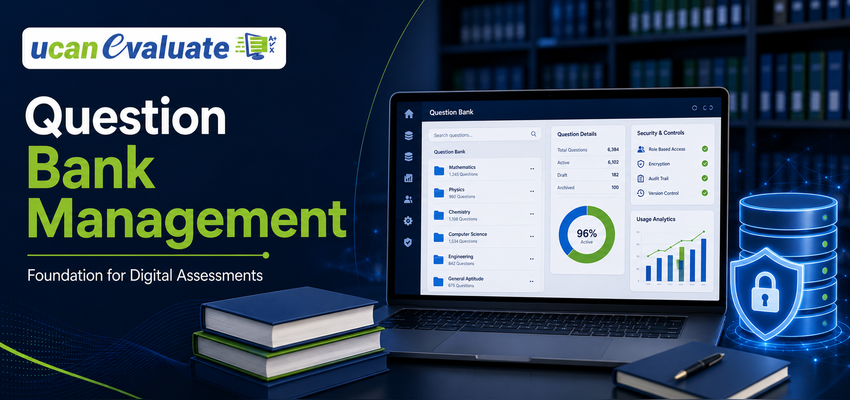
Question Bank Management is the systematic process of creating, storing, categorising, reviewing and maintaining examination questions in a centralised digital repository.
Instead of maintaining questions across spreadsheets, documents or disconnected systems, universities can use a structured question bank to organise questions according to parameters such as:
- Course and subject
- Programme and semester
- Unit or topic
- Question type
- Difficulty level
- Learning objective
- Marks or weightage
- Academic year
- Question status
A well-designed question bank is therefore more than a collection of questions. It becomes an academic resource that supports consistent and controlled assessment planning.
Why Question Bank Management Matters in Digital Assessments
Moving examinations online does not automatically make the assessment process efficient. Universities also need a reliable method for managing the content that powers those examinations.
An effective question bank can help institutions improve several aspects of examination management.
Better Organisation
Questions can be classified and retrieved using predefined categories, making it easier for authorised academic teams to find appropriate questions when preparing assessments.
Greater Consistency
Standardised workflows can help maintain consistency in question creation, review and approval across departments and programmes.
Improved Security
Examination questions are sensitive academic assets. A controlled digital repository can restrict access according to user roles and responsibilities, reducing unnecessary exposure.
Faster Exam Preparation
When approved questions are already organised in a central repository, examination teams can spend less time searching through separate files and more time focusing on assessment quality.
Building a Structured Digital Question Bank
The effectiveness of a question bank depends largely on how it is structured.
A university may have thousands of questions across multiple programmes. Without a clear taxonomy, finding the right question can become difficult.
A structured repository should allow questions to be mapped against relevant academic parameters. For example, a question could be tagged with its subject, unit, learning outcome, difficulty level and marks.
This makes the question bank easier to search, review and reuse when appropriate.
It also creates a stronger connection between academic planning and the wider Pre Examination Processing workflow.
Question Creation and Review Should Work Together
A question should not move directly from creation to examination deployment.
A controlled workflow can include multiple stages:
Question Creation → Review → Moderation → Approval → Question Bank → Examination Paper → Secure Distribution
This approach gives academic teams opportunities to verify accuracy, relevance, difficulty and alignment with learning outcomes before a question becomes part of an examination.
Role-based workflows can also ensure that question creators, reviewers, moderators and administrators have clearly defined responsibilities.
Question Bank Management and Examination Security
Security is one of the most important considerations when digitising examination processes.
A question bank may contain questions for upcoming examinations, making unauthorised access a significant concern. Universities should therefore consider controls such as authentication, role-based permissions, activity logs and controlled access to sensitive content.
Security should also continue beyond the question bank.
Once questions are selected for an examination, the resulting paper must be protected through the subsequent stages of examination processing and distribution.
This creates a connected security chain:
Question Bank → Paper Creation → Approval → Secure Distribution → Examination → Evaluation → Results
A digital assessment ecosystem is strongest when security is considered across the entire lifecycle rather than at one individual stage.
Supporting Different Types of Questions
Modern assessments may include more than conventional descriptive questions.
Depending on the academic requirement, a digital question bank may need to support different formats, including:
- Multiple-choice questions
- Short-answer questions
- Descriptive questions
- Numerical questions
- Case-based questions
- Scenario-based questions
- Subject-specific question formats
The system should also support appropriate metadata and marking information for each question type.
This becomes particularly useful when universities are moving toward Online Assessment and blended examination models.
Question Banks and Online Examination Systems
A question bank can provide the content foundation for an Online Examination System.
Instead of manually preparing every digital examination from disconnected files, authorised users can select approved questions from a central repository based on predefined requirements.
For example, an examination could require:
- A specific number of questions
- Defined marks distribution
- Questions from selected units
- A particular difficulty mix
- Specific question types
A structured repository makes these requirements easier to manage.
However, automation should support academic decision-making rather than replace it. Faculty and examination authorities should retain appropriate control over question selection and final examination approval.
From Question Bank to Digital Evaluation
Question Bank Management is also connected to what happens after an examination.
In a conventional examination workflow, students may write answers in physical booklets. These can then move through Answer booklet scanning, script management and evaluation.
In a digital examination environment, responses may move directly into a Digital Evaluation System.
For handwritten examinations, Scanning of Answer Sheets can digitise physical scripts and prepare them for secure evaluation. Evaluators can then access digital scripts through an On Screen Evaluation System or On Screen Marking System, depending on the institution’s workflow.
This creates a broader digital chain:
Question Management → Examination → Answer Booklet Scanning → Digital Evaluation → Results
The question bank therefore sits at the beginning of a much larger examination ecosystem.
Connecting Question Bank Management With University Examination Systems
Universities often use multiple technologies for different stages of the examination lifecycle.
The challenge is ensuring that these systems work together.
A modern University Examination System can connect question management with:
- Pre Examination Processing
- Examination scheduling
- Question paper generation
- Secure paper distribution
- Online Examination System
- Answer booklet scanning
- On Screen Evaluation
- On Screen Marking
- Post Examination Processing
- Result preparation
When these stages are connected, universities can reduce repetitive manual work and improve visibility across the examination process.
This is particularly valuable for institutions managing examinations across multiple campuses, affiliated colleges or large student populations.
How to Maintain a High-Quality Question Bank
Creating a large question bank is not enough. Its quality must be maintained over time.
Universities should periodically review questions for:
- Accuracy
- Relevance
- Curriculum alignment
- Difficulty
- Duplication
- Outdated content
- Learning-outcome alignment
- Appropriate marks allocation
Questions that are no longer relevant should be archived or updated rather than remaining active indefinitely.
Version control can also help academic teams track changes and maintain a clear history of question revisions.
Common Challenges in Question Bank Management
Universities may face several challenges when managing question repositories manually or through disconnected systems.
These include:
- Duplicate questions across departments
- Difficulty tracking approved questions
- Unclear review responsibilities
- Unauthorised access
- Poor categorisation
- Outdated questions
- Time-consuming paper creation
- Limited visibility into question usage
A centralised and structured approach can help address these challenges while providing academic teams with greater control.
Why Question Bank Management Is the Foundation of Digital Assessment
Digital assessment is often viewed primarily through the lens of examination platforms or Online Exam Solutions. But the quality of the assessment depends heavily on what happens before the examination begins.
A strong question bank supports the academic side of assessment while digital examination systems manage delivery, response capture and evaluation.
When these components are integrated, universities can move towards a more connected Examination Processing ecosystem.
The result is not simply a paperless examination. It is a more structured approach to assessment management.
Building a Smarter Digital Examination Ecosystem
For universities planning or expanding their digital transformation, Question Bank Management should be treated as a core component rather than an isolated feature.
A well-managed question repository can provide the foundation for secure paper creation, online assessments and downstream evaluation workflows. Combined with On-Screen Marking, digital evaluation and post-examination processing, it can support a more coordinated examination lifecycle.
The objective is simple: put the right question in the right assessment, through the right process, with the right controls.
Learning Spiral helps institutions explore technology-driven approaches to examination management, from question and assessment workflows to Digital Evaluation Systems, on-screen marking and broader university examination processes.
Looking to strengthen your university’s digital assessment ecosystem? Connect with Learning Spiral to explore a secure and integrated approach to examination processing.