What This Article Covers
- What end-to-end digital evaluation actually means, beyond just “on-screen marking”
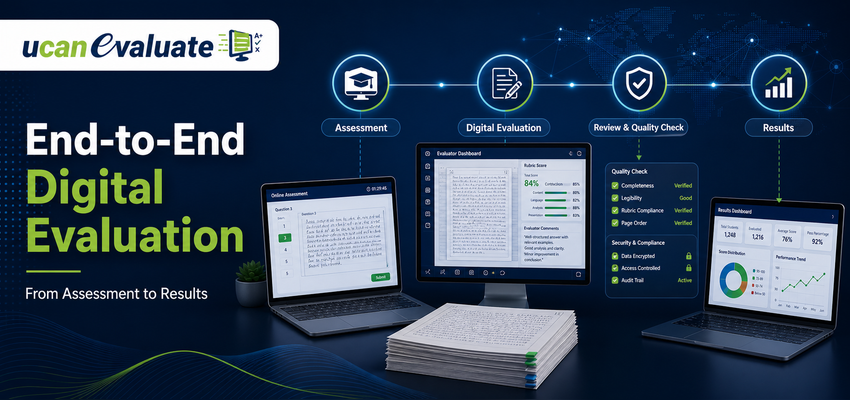
- The five connected stages, from assessment design to final result declaration
- A decision framework for choosing where to start your digital transition
- Manual vs. digital evaluation: a side-by-side comparison
- Common pitfalls universities and boards run into during digitisation
- FAQs examination administrators are actively searching for
- Where to go next if you’re evaluating a partner for this transition
The Hidden Cost of a Broken Evaluation Chain
Most Controllers of Examinations don’t lose sleep over on-screen marking software. They lose sleep over what happens between the stages — when scanned scripts sit in a queue waiting for evaluator allocation, when a moderation flag doesn’t sync back to the tabulation sheet, or when a result that should have taken ten days takes thirty because three separate systems don’t talk to each other.
This is the real problem with how most institutions think about digital evaluation. They treat it as a single tool — “we bought an on-screen marking system” — rather than as a connected process that spans pre-examination setup, scanning, evaluation, moderation, tabulation, and result declaration. When any one link in that chain is still manual or disconnected, the entire cycle inherits its slowest, most error-prone step.
For an institution processing anywhere from a few thousand to several lakh answer scripts per examination cycle, that gap is not a minor inconvenience. It shows up as delayed semester results, a spike in revaluation requests, and — increasingly, under NEP 2020’s emphasis on transparent, outcome-based assessment — genuine compliance risk.
What Is End-to-End Digital Evaluation?
End-to-end digital evaluation is the integration of every post-assessment stage — answer booklet scanning, on-screen marking, moderation, grievance handling, tabulation, and result processing — into a single connected digital workflow, rather than a collection of standalone tools. Institutions using an end-to-end approach typically see evaluation turnaround improve by 40–50%, with far fewer manual handoffs and tabulation errors.
The Five Stages of a Connected Digital Evaluation Workflow
1. Pre-Examination Processing
Before a single script is evaluated, the groundwork determines how smoothly everything downstream will run:
- Question bank management and paper generation with built-in randomisation
- Hall ticket and seating plan generation
- Examiner and evaluator empanelment, with conflict-of-interest checks
- Answer booklet barcoding for anonymised, tamper-evident tracking
2. Scanning and Digitisation
- High-speed, high-fidelity scanning of answer booklets
- Automated quality checks to flag skewed, blank, or missing pages before they reach an evaluator
- Barcode-based script identification that removes any link between a script and a student’s identity during marking
3. On-Screen Marking and Evaluation
- Rule-based, randomised allocation of scripts to evaluators to prevent bias and overload
- Real-time tracking of evaluator progress and turnaround
- Built-in double-valuation and third-valuation triggers based on configurable variance thresholds
- Digital annotation tools that preserve a full audit trail of every mark awarded
4. Moderation and Quality Control
- Statistical moderation dashboards to flag lenient or harsh evaluators before results are finalised
- Head examiner review workflows for spot-checks and sample audits
- Automatic escalation of scripts with unusually high mark variance
5. Post-Examination Processing and Result Declaration
- Automated tabulation directly from evaluated scripts — no manual re-entry
- Grade computation as per institutional or regulatory grading schemes (CBCS, CGPA, absolute)
- Instant-access digital grievance and revaluation workflows
- Result publication integrated with the university management system and student portals
Digital evaluation is not just a technology upgrade — it’s the difference between a fair result and a delayed, disputed one.
Decision Framework: Where Should Your Institution Start?
Not every institution needs to digitise all five stages simultaneously. Use this framework to identify your starting point based on where your current process is weakest.
| If your biggest pain point is… | Start with… | Typical impact |
|---|---|---|
| Result delays after exams | On-screen marking + automated tabulation | 40–50% faster turnaround |
| High volume of revaluation disputes | Digital moderation + transparent grievance workflow | Significant drop in grievance volume |
| Errors in manual mark transcription | End-to-end evaluation-to-tabulation integration | Near-elimination of transcription errors |
| Evaluator bias or inconsistency complaints | Randomised allocation + statistical moderation dashboards | Improved evaluator accountability |
| Scattered systems that don’t sync | Full end-to-end digital evaluation platform | Single source of truth across the exam lifecycle |
Manual Evaluation vs. On-Screen/Digital Evaluation
| Parameter | Manual Evaluation | On-Screen / Digital Evaluation |
|---|---|---|
| Turnaround time (per 1 lakh scripts) | 4–6 weeks typical | 10–15 days typical |
| Evaluator allocation | Manual, often ad hoc | Rule-based, randomised, auditable |
| Anonymity of scripts | Dependent on manual masking | Barcode-based, systemic anonymity |
| Moderation | Retrospective, sample-based | Real-time, statistical, dashboard-driven |
| Tabulation errors | Common, manual re-entry required | Minimal, direct system integration |
| Grievance/revaluation handling | Paper-based, slow | Digital, trackable, faster resolution |
| Audit trail | Limited or paper-based | Complete digital audit trail |
| Storage and retrieval | Physical, degrades over time | Digital, instantly retrievable |
Common Pitfalls During Digital Transition
Institutions moving from manual to digital evaluation tend to repeat the same mistakes. Recognising them early can save a cycle or two of avoidable disruption.
| Pitfall | Why It Happens | How to Avoid It |
|---|---|---|
| Digitising evaluation but not tabulation | Treating on-screen marking as the “whole” solution | Choose a platform that connects evaluation directly to result processing |
| Underestimating evaluator training needs | Assuming digital tools are self-explanatory | Run structured onboarding and pilot cycles before full rollout |
| No fallback for scanning quality issues | Over-reliance on automated checks alone | Build manual QC checkpoints for flagged scripts |
| Ignoring data security and access controls | Focus on speed over governance | Ensure role-based access, encryption, and compliance with institutional data policies |
| Rolling out to all departments at once | Pressure to show quick, university-wide impact | Pilot with one faculty or one examination cycle first |
| Not aligning with NEP 2020 assessment norms | Legacy grading structures carried over unchanged | Review outcome-based assessment and CBCS/CGPA compliance during setup |
Why Institutional Experience Matters
Examination technology is not a generic software category — it sits at the intersection of academic policy, data security, and operational scale. Learning Spiral Ltd. has worked as a technology partner to universities, higher education institutes, school boards, and examination and recruitment boards across India for over 25 years, supporting more than 100 institutions through exactly this kind of transition. That depth of exposure — across countless examination cycles, grading structures, and regulatory contexts — tends to matter more than any single feature comparison when an institution is choosing how to modernise its evaluation process.
Frequently Asked Questions
- What is on-screen evaluation and how is it different from digital evaluation?
On-screen evaluation refers specifically to the marking of scanned answer scripts on a screen rather than on paper. Digital evaluation is broader — it includes on-screen marking as one stage within a connected workflow that also covers scanning, moderation, tabulation, and result processing. - Is on-screen evaluation legally valid for university exams in India?
Yes. On-screen evaluation is widely adopted across Indian universities and examination boards and is recognised as a valid evaluation method, provided institutions follow their own statutory examination regulations and maintain proper audit trails, consistent with UGC and AICTE guidance on assessment integrity. - How long does digital evaluation take for 1 lakh answer scripts?
With a properly configured on-screen marking and tabulation workflow, institutions typically process around 1 lakh answer scripts in 10 to 15 days, compared to 4 to 6 weeks for a fully manual process — though actual timelines depend on evaluator availability and moderation requirements. - Does digital evaluation reduce revaluation and grievance requests?
Institutions that combine randomised, anonymised evaluator allocation with real-time statistical moderation generally see a meaningful reduction in revaluation requests, since inconsistent marking is caught and corrected before results are declared rather than after. - What is the difference between on-screen marking and post-examination processing? On-screen marking is the act of evaluating a scanned script digitally. Post-examination processing is everything that happens after marking is complete — tabulation, grade computation, grievance handling, and result declaration — and it’s this connective layer that determines whether digital evaluation actually saves an institution time.
Where to Go From Here
Digitising evaluation in isolation solves one bottleneck while leaving several others untouched. The institutions that see the biggest gains – in turnaround time, in reduced disputes, in student trust – are the ones that treat evaluation and result processing as a single connected system.
If you’re mapping out where your institution’s process needs the most attention, it’s worth exploring how faster semester results are achieved end-to-end, or looking at how secured online assessments fit into a broader digital transformation strategy. You can also book a demo to walk through how this would map onto your institution’s current examination cycle.
For further context on regulatory expectations, the UGC’s guidelines on examination reforms and the NEP 2020 policy document are useful references for aligning any digital transition with current academic policy.