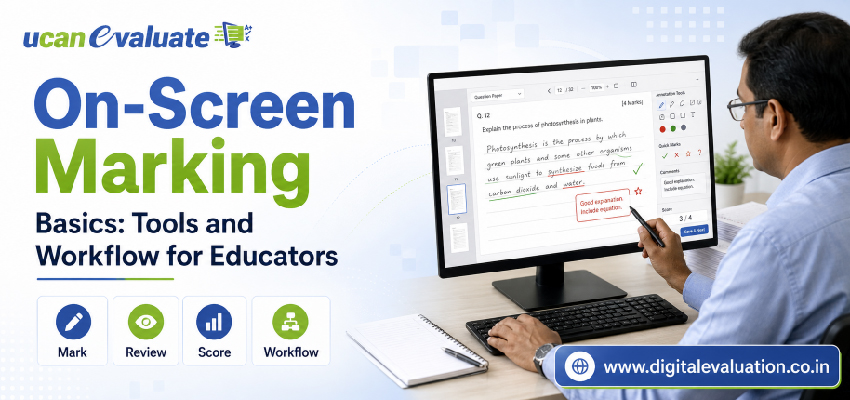
On-Screen Marking (OSM) is a digital evaluation process where scanned answer scripts are assessed electronically rather than through traditional paper-based methods. As part of a modern Digital Evaluation System, it enables educators to evaluate answer sheets securely from any location while maintaining consistency and transparency.
Many universities and examination authorities are adopting On-Screen Evaluation to streamline examination processing, improve result timelines, and enhance assessment quality.
Key Tools Used in On-Screen Marking
A robust On-Screen Marking System typically includes several integrated tools that support the complete evaluation lifecycle.
1. Answer Booklet Scanning
Physical answer sheets are digitized through high-quality scanning processes. Proper Scanning of Answer Sheets ensures clear images for accurate evaluation and secure archival.
2. Allocation and Examiner Management
The system automatically assigns scripts to evaluators based on predefined rules, reducing manual intervention and improving operational efficiency.
3. Digital Marking Interface
Evaluators can:
- Mark responses digitally
- Add annotations and comments
- Award marks question-wise
- Review previously evaluated answers
- Access marking schemes instantly
4. Quality Control Mechanisms
Advanced systems include:
- Double evaluation workflows
- Random moderation
- Audit trails
- Exception handling
These features significantly improve fairness and consistency.
Typical On-Screen Marking Workflow
The workflow generally follows five stages:
Step 1: Pre Examination Processing
Institutions configure examination parameters, examiner details, course structures, and evaluation rules.
Step 2: Answer Script Digitization
Answer booklets are scanned and securely uploaded into the system.
Step 3: Script Distribution
The On Screen Evaluation System automatically allocates scripts to authorized evaluators.
Step 4: Digital Evaluation
Examiners assess responses using the digital interface while adhering to predefined marking guidelines.
Step 5: Post Examination Processing
Marks are consolidated, verified, moderated, and prepared for result generation.
This structured workflow helps institutions accelerate examination processing while maintaining quality standards.
Benefits of On-Screen Marking
Educational institutions increasingly prefer On-Screen Evaluation because it offers:
- Faster result declaration
- Improved evaluation accuracy
- Enhanced examiner productivity
- Greater transparency and accountability
- Secure data management
- Reduced logistics and paper handling costs
For large universities managing thousands of answer scripts, these advantages can significantly improve operational efficiency.
Common Challenges and Solutions
Despite its advantages, institutions may encounter certain challenges during implementation.
Challenge: Resistance to Change
Some evaluators may be unfamiliar with digital tools.
Solution: Structured training programs and intuitive interfaces encourage faster adoption.
Challenge: Managing Large Volumes
High-volume examinations require scalable infrastructure.
Solution: Cloud-enabled University Examination System platforms ensure reliable performance during peak evaluation periods.
Challenge: Data Security
Examination data is highly sensitive.
Solution: Modern systems incorporate encryption, role-based access controls, and audit logs to ensure security and compliance.
Future of On-Screen Evaluation
The future of Digital Evaluation is closely linked with automation and artificial intelligence. Emerging technologies are enabling:
- AI-assisted evaluation workflows
- Automated anomaly detection
- Intelligent examiner allocation
- Performance analytics dashboards
- Seamless integration with University Management System platforms
These innovations are helping institutions create more efficient, transparent, and scalable assessment ecosystems.
On-Screen Marking has evolved from a convenience tool into a critical component of modern examination management. By combining Answer Booklet Scanning, Digital Evaluation, and structured workflows, institutions can improve accuracy, efficiency, and transparency across the assessment lifecycle.
Learning Spiral has helped universities and examination authorities modernize their evaluation processes through scalable, secure, and user-friendly digital examination solutions.
Looking to modernize your assessment workflow?
Explore Learning Spiral’s complete suite of University Examination System, Online Assessment, Digital Evaluation, and Examination Processing solutions, or request a personalized demo to see how digital evaluation can transform your institution.