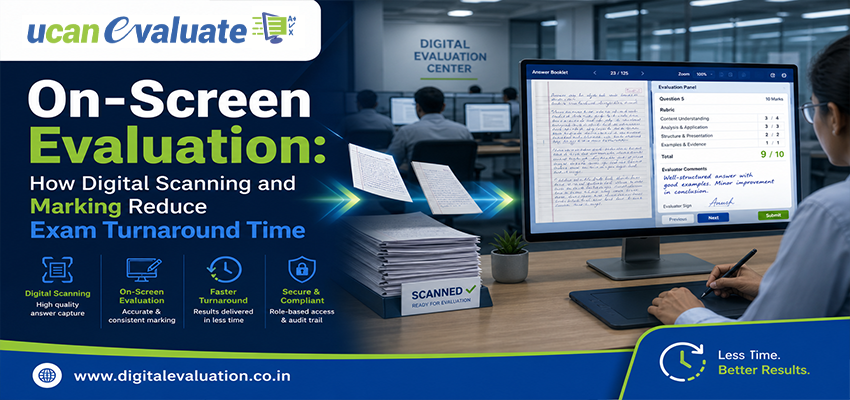
Every exam season, universities face the same silent crisis – mountains of answer sheets, overworked evaluators, and a results timeline that keeps slipping. Students wait anxiously. Administrators fight logistics. And somewhere in a warehouse, thousands of physical booklets sit waiting to be checked by hand.
This is exactly the problem On Screen Evaluation was built to solve.
By digitizing the entire evaluation lifecycle — from scanning to marking to result generation — modern universities are cutting turnaround time by weeks, not days. Let’s break down how.
What Is On-Screen Evaluation, Really?
On-Screen Evaluation (also written as On-Screen Evaluation System) is the process of evaluating scanned digital copies of answer sheets on a computer screen instead of physically marking paper booklets with a red pen. Evaluators log into a secure portal, view a candidate’s scanned response sheet, and award marks digitally — question by question.
It sounds simple, but the ripple effect on speed, accuracy, and transparency is massive. This shift is part of a broader global move toward educational assessment technologies that reduce human error and administrative overhead.
Step One: Answer Booklet Scanning
Before any marking happens, physical answer booklets go through high-speed Answer Booklet Scanning. Every page is captured as a high-resolution digital image, indexed against the candidate’s roll number (with identity masked for fairness), and uploaded to a secure evaluation server.
This single step eliminates:
- Lost or misplaced physical booklets
- Damage during transport between exam centres and evaluation hubs
- Delays caused by physically distributing bundles to evaluators in different cities
Once scanned, thousands of booklets become instantly accessible to any authorized evaluator, anywhere.
Step Two: On-Screen Marking
This is where the real transformation happens. On-Screen Marking allows evaluators to award marks directly on the digital copy using a structured, question-wise interface. Unlike a physical answer sheet, an On Screen Marking System can:
- Auto-calculate totals (no manual addition errors)
- Flag missing evaluations or skipped questions
- Enable double evaluation and moderation with a single click
- Maintain a complete audit trail of who marked what, and when
Because evaluators no longer need to travel to a physical centre, universities can pull in subject experts from anywhere in the country — drastically increasing evaluation capacity during peak exam season.
Why Universities Are Moving to a Digital Evaluation System
A Digital Evaluation System isn’t just about scanning and marking — it’s a complete ecosystem covering the exam lifecycle. This typically breaks down into three phases:
1. Pre Examination Processing
Includes question paper setting, randomization, printing coordination, and hall ticket generation — all managed digitally before the exam even begins.
2. Examination Processing
Covers attendance capture, seating arrangements, and real-time monitoring during the exam window.
3. Post Examination Processing
This is where scanning, On-Screen Evaluation, tabulation, and result publishing happen — the phase most universities struggle with when relying on manual methods.
By automating all three phases through one connected platform, institutions eliminate the handoff delays that traditionally stack up between departments.
The Backbone: University Examination System Integration
None of this works in isolation. A robust University Examination System ties scanning, marking, result processing, and student records into a single dashboard. Combined with a broader University Management System, institutions get:
- Real-time visibility into evaluation progress
- Centralized data instead of scattered spreadsheets
- Faster grievance redressal, since original scanned copies are instantly retrievable
- Reduced administrative burden on exam cells
Question Bank Management: The Unsung Hero
Good evaluation starts long before the exam. A strong Question Bank Management system helps institutions store, tag, and reuse vetted questions by difficulty, subject, and syllabus mapping. This reduces the workload of setting fresh papers every cycle and ensures consistent question quality across sessions — directly improving the reliability of the evaluation that follows.
Beyond the Classroom: Online Examination Systems and Online Assessment
The same digital backbone powering On-Screen Evaluation also supports fully remote testing. An Online Examination System enables institutions to conduct proctored tests over the internet, while Online Assessment tools allow instant, objective-type scoring for MCQ-based papers.
This is closely tied to techniques like optical mark recognition, which many Online Exam Solutions use to auto-score bubble sheets at scale — a technology that’s been quietly powering standardized testing for decades and now feeds directly into modern digital evaluation pipelines.
Together, these tools form a complete Online Exam Solution — covering everything from question delivery to final grade declaration.
The Real-World Impact: Faster Results, Fewer Errors
Universities that have adopted end-to-end Digital Evaluation report:
- 40–60% faster result declaration compared to manual evaluation cycles
- Near-zero addition or tabulation errors
- Reduced re-evaluation requests, since scanned copies provide instant proof
- Lower administrative costs from eliminated printing, transport, and storage
For institutions handling lakhs of answer sheets every semester, this isn’t a minor efficiency gain — it’s the difference between a results day that runs smoothly and one that spirals into chaos.
Final Thoughts
The shift from red-pen marking to a connected On-Screen Evaluation System isn’t just a technology upgrade – it’s a fundamental rethink of how examinations should work in a digital-first education system. From Scanning of Answer Sheets to On-Screen Marking, from Pre Examination Processing to Post Examination Processing, every stage becomes faster, more transparent, and more accountable.
If your institution is still relying on manual evaluation, the turnaround-time gap between you and digitally-enabled universities is only going to widen.