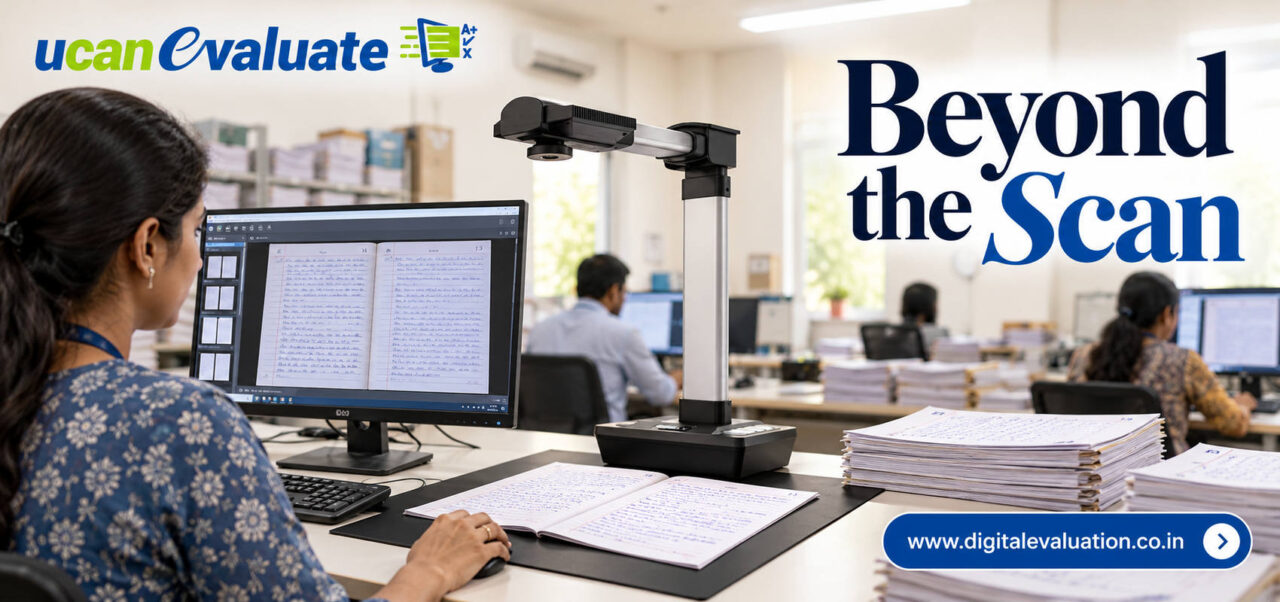
Your examination is over. Your answer booklet has been collected and scanned. But what happens next?
Does your answer sheet immediately reach an examiner? How are your handwritten responses protected? Who verifies the marks before the university announces results?
For students, scanning might seem like the final step in handling a physical answer booklet. For universities, however, it is only the beginning of a carefully managed digital evaluation journey.
Modern Answer Booklet Scanning transforms handwritten examination scripts into secure digital records that can be tracked, assigned, evaluated, reviewed, and processed without repeatedly transporting the original paper.
With Learning Spiral Ltd.’s Digital Evaluation System, universities can connect scanning, examiner allocation, on-screen marking, quality checks, and result processing into a more efficient academic workflow.
Let’s follow the journey of an answer sheet after scanning and discover how technology supports accuracy, security, and timely examination results.
1. Your Answer Sheet Gets a Digital Identity
The journey starts even before the scanner captures the first page.
After examinations, physical answer booklets are collected, checked, and organized according to the institution’s examination records. Unique barcodes or identification references help connect the physical scripts with their corresponding digital versions.
Once scanned, the pages become digital images associated with the correct examination details.
This is where Scanning of Answer Sheets becomes more than a document conversion activity. It establishes the foundation for tracking each script throughout the evaluation lifecycle.
The purpose is straightforward: the university needs to know which answer booklet has been received, which pages belong to it, and whether the digital copy is ready for assessment.
Without reliable indexing and traceability, even an advanced evaluation platform can face avoidable administrative challenges.
2. Every Scanned Page Goes Through Quality Checks
Imagine an examiner opening a scanned answer booklet and discovering that an entire page is missing.
A single scanning error could affect the evaluation of a student’s work.
That is why scanning quality assurance is essential.
After digitization, the examination workflow should verify that scanned images are readable, complete, correctly oriented, and arranged in the proper sequence.
Common issues include blurred handwriting, missing pages, duplicate images, incorrect page order, and mismatched identification details.
These checks may involve automated controls, trained scanning operators, or both.
The underlying practice is associated with Document Imaging, where physical documents are converted into digital representations suitable for storage and further processing.
High-quality scanning creates the conditions for accurate evaluation. The objective is not simply to capture a document but to ensure that examiners can assess the student’s complete response.
3. Your Answer Booklet Enters Secure Digital Storage
Once a scanned script passes the required checks, it can be uploaded into the university’s secure digital evaluation environment.
Instead of circulating physical answer sheets between examination centres and evaluation locations, institutions can maintain controlled digital access to scripts.
A secure Digital Evaluation System helps protect sensitive examination information through measures such as encrypted storage, authentication, and authorized user access.
Learning Spiral’s digital evaluation workflow includes identity masking and controlled access features designed to support the confidentiality of student records.
The distinction is important: scanning creates the digital file, while secure storage and access management help protect it throughout subsequent processing.
Depending on the institution’s regulations, physical answer booklets may also be preserved according to established retention and record-management policies.
4. Student Identity Can Be Hidden Before Evaluation
Fairness is one of the most important expectations in university examinations.
An evaluator should assess the quality of the student’s response rather than be influenced by identifying information.
A secure On-Screen Evaluation workflow can support this objective through student identity masking.
Where the university’s policy requires anonymized evaluation, candidate details can be concealed from examiners while authorized administrators retain the information needed for final marks processing.
The evaluator sees the answer script and the academic information required for marking, rather than unnecessary personal details.
This separation helps institutions implement consistent evaluation procedures and strengthens confidence in the assessment process.
5. The Digital Answer Sheet Is Assigned to an Examiner
After indexing, verification, and security checks, the scanned booklet is ready for allocation.
Traditional examination workflows often depend on moving bundles of answer scripts physically between departments and evaluators.
A digital system changes this process.
Through a structured On Screen Marking System, universities can allocate scanned answer booklets according to subject expertise, evaluator availability, workload distribution, and institutional rules.
Learning Spiral’s evaluation platform supports random or customized script allocation, giving examination administrators flexibility in managing the process.
Authorized examiners can access their assigned answer scripts through the evaluation interface.
This removes unnecessary dependence on the physical distribution of booklets and makes it easier to monitor the progress of marking.
For universities managing large volumes of examination scripts, organized digital allocation can significantly simplify coordination.
6. The Examiner Checks Your Answers on a Screen
This is the stage where the actual academic evaluation takes place.
Using an On-Screen Marking interface, the examiner opens the scanned answer booklet and reviews the student’s handwritten responses digitally.
The examiner can record marks against individual questions, use available annotation tools, and follow the university’s approved marking instructions.
Unlike basic document viewing software, a dedicated On-Screen Marking System connects the evaluated script with structured marks capture and monitoring.
This can reduce dependence on manual mark sheets and separate data-entry processes.
Most importantly, digitization does not automatically mean that a machine grades every subjective response.
Qualified evaluators remain responsible for academic judgment, while technology supports the workflow surrounding their decisions.
This combination of human expertise and digital process controls makes on-screen evaluation particularly relevant for universities that continue conducting handwritten theory examinations.
7. Marks Are Checked Before Final Approval
Once an examiner finishes marking, the process is not necessarily complete.
Universities must ensure that the evaluation follows their academic policies and quality standards.
An effective Digital Evaluation System can support checks for unanswered marking fields, incomplete evaluation, unusual marking patterns, and scripts requiring additional review.
Depending on institutional rules, selected scripts may undergo moderation, second evaluation, or authorized verification.
Digital marks capture can also reduce errors associated with transferring handwritten marks into separate spreadsheets or registers.
However, technology is not a substitute for academic oversight. Examination controllers, moderators, and authorized university officials remain essential to the approval process.
By combining structured marking with controlled review, institutions can make evaluation more accountable and easier to audit.
8. Your Marks Move Into Result Processing
After evaluation and the required approvals, the recorded marks proceed to the next stage.
This is where Post Examination Processing becomes critical.
Approved marks can be compiled and processed according to the university’s examination rules, including applicable moderation decisions, assessment components, and result-calculation requirements.
Rather than repeatedly transferring information from physical answer books to manual marks registers, connected digital workflows can reduce administrative duplication.
A well-integrated University Examination System brings together evaluation records, marks processing, approval workflows, and result preparation.
For students, the ultimate outcome is a timely and reliable result.
For universities, it is a more transparent process with improved visibility into the status of evaluation and marks compilation.
9. Your Digital Answer Sheet Can Support Rechecking and Audits
What happens when a student requests verification of marks or when a university needs to review an evaluation decision?
Digital records can make the process easier to manage.
Subject to the university’s policies, authorized officials may retrieve scanned answer booklets, examine recorded marks, and review relevant evaluation information.
This can be useful during rechecking, moderation, academic audits, grievance handling, and other approved review processes.
The digital document-management approach also relates to Document Processing, which includes the conversion and structured handling of information from physical documents.
Maintaining accessible, protected evaluation records helps universities balance operational efficiency with academic accountability.
Access, retention, disclosure, and revaluation must continue to follow the institution’s examination rules and applicable data-protection requirements.
10. How Digital Evaluation Connects the Entire University Examination Process
An answer sheet’s journey does not exist in isolation.
It is connected to a wider examination ecosystem that may include Pre Examination Processing, candidate records, examination scheduling, assessment administration, and result publication.
Universities may also operate Question Bank Management solutions, an Online Examination System, or Online Assessment platforms for different assessment formats.
A University Management System may maintain broader academic and administrative records, while a specialized On Screen Evaluation System manages scanned-script assessment.
These systems serve different purposes, but effective integration can reduce repetitive work and help institutions maintain consistent examination information.
Learning Spiral Ltd. supports this transformation through digital examination and evaluation solutions designed around institutional workflows.
The goal is not simply to replace paper with screens. It is to build a connected process in which answer scripts, evaluation records, and approved marks are managed more efficiently.
Why Universities Should Care About What Happens After Scanning
Universities often focus on scanner speed and the number of answer sheets that can be digitized in a day.
But the real value of digital evaluation emerges after scanning.
A successful workflow must ensure that the correct script reaches the correct evaluator, that all required pages are visible, that marks are captured accurately, and that authorized officials can monitor completion.
When these stages work together, institutions can reduce physical handling, improve traceability, strengthen evaluation controls, and shorten avoidable administrative delays.
A reliable system must support both academic integrity and operational efficiency.
That is why institutions evaluating digital examination technology should look beyond scanning infrastructure and consider the complete lifecycle of each answer booklet.
How Learning Spiral Ltd. Supports Digital Answer Sheet Evaluation
Learning Spiral Ltd. helps universities and examination authorities modernize the assessment of handwritten examination scripts through structured digital evaluation workflows.
Its solutions support answer booklet scanning, secure digital storage, evaluator allocation, on-screen marking, marks collation, and result-processing activities.
With features such as identity masking, controlled access, digital annotations, allocation workflows, and examination reporting, Learning Spiral helps institutions manage the movement from paper-based scripts to screen-based evaluation.
For universities seeking greater transparency, operational control, and efficiency, a connected evaluation workflow can provide a practical path toward examination modernization.
Conclusion: Scanning Is Only the Beginning
The next time you hear that university answer sheets have been scanned, remember that the digital journey has only started.
The scanned booklet must be verified, securely stored, allocated to an authorized evaluator, marked, reviewed, and processed before the final result is approved.
Every stage matters.
A well-designed Digital Evaluation System helps universities connect these steps into one organized workflow, supporting accurate marking, secure examination management, and timely results.
Ready to modernize your university’s answer sheet evaluation process
What Happens to Your Answer Sheet After Scanning? The Digital Evaluation Journey Explained
Your examination is over. Your answer booklet has been collected and scanned. But what happens next?
Does your answer sheet immediately reach an examiner? How are your handwritten responses protected? Who verifies the marks before the university announces results?
For students, scanning might seem like the final step in handling a physical answer booklet. For universities, however, it is only the beginning of a carefully managed digital evaluation journey.
Modern Answer Booklet Scanning transforms handwritten examination scripts into secure digital records that can be tracked, assigned, evaluated, reviewed, and processed without repeatedly transporting the original paper.
With Learning Spiral Ltd.’s Digital Evaluation System, universities can connect scanning, examiner allocation, on-screen marking, quality checks, and result processing into a more efficient academic workflow.
Let’s follow the journey of an answer sheet after scanning and discover how technology supports accuracy, security, and timely examination results.
1. Your Answer Sheet Gets a Digital Identity
The journey starts even before the scanner captures the first page.
After examinations, physical answer booklets are collected, checked, and organized according to the institution’s examination records. Unique barcodes or identification references help connect the physical scripts with their corresponding digital versions.
Once scanned, the pages become digital images associated with the correct examination details.
This is where Scanning of Answer Sheets becomes more than a document conversion activity. It establishes the foundation for tracking each script throughout the evaluation lifecycle.
The purpose is straightforward: the university needs to know which answer booklet has been received, which pages belong to it, and whether the digital copy is ready for assessment.
Without reliable indexing and traceability, even an advanced evaluation platform can face avoidable administrative challenges.
2. Every Scanned Page Goes Through Quality Checks
Imagine an examiner opening a scanned answer booklet and discovering that an entire page is missing.
A single scanning error could affect the evaluation of a student’s work.
That is why scanning quality assurance is essential.
After digitization, the examination workflow should verify that scanned images are readable, complete, correctly oriented, and arranged in the proper sequence.
Common issues include blurred handwriting, missing pages, duplicate images, incorrect page order, and mismatched identification details.
These checks may involve automated controls, trained scanning operators, or both.
The underlying practice is associated with Document Imaging, where physical documents are converted into digital representations suitable for storage and further processing.
High-quality scanning creates the conditions for accurate evaluation. The objective is not simply to capture a document but to ensure that examiners can assess the student’s complete response.
3. Your Answer Booklet Enters Secure Digital Storage
Once a scanned script passes the required checks, it can be uploaded into the university’s secure digital evaluation environment.
Instead of circulating physical answer sheets between examination centres and evaluation locations, institutions can maintain controlled digital access to scripts.
A secure Digital Evaluation System helps protect sensitive examination information through measures such as encrypted storage, authentication, and authorized user access.
Learning Spiral’s digital evaluation workflow includes identity masking and controlled access features designed to support the confidentiality of student records.
The distinction is important: scanning creates the digital file, while secure storage and access management help protect it throughout subsequent processing.
Depending on the institution’s regulations, physical answer booklets may also be preserved according to established retention and record-management policies.
4. Student Identity Can Be Hidden Before Evaluation
Fairness is one of the most important expectations in university examinations.
An evaluator should assess the quality of the student’s response rather than be influenced by identifying information.
A secure On-Screen Evaluation workflow can support this objective through student identity masking.
Where the university’s policy requires anonymized evaluation, candidate details can be concealed from examiners while authorized administrators retain the information needed for final marks processing.
The evaluator sees the answer script and the academic information required for marking, rather than unnecessary personal details.
This separation helps institutions implement consistent evaluation procedures and strengthens confidence in the assessment process.
5. The Digital Answer Sheet Is Assigned to an Examiner
After indexing, verification, and security checks, the scanned booklet is ready for allocation.
Traditional examination workflows often depend on moving bundles of answer scripts physically between departments and evaluators.
A digital system changes this process.
Through a structured On Screen Marking System, universities can allocate scanned answer booklets according to subject expertise, evaluator availability, workload distribution, and institutional rules.
Learning Spiral’s evaluation platform supports random or customized script allocation, giving examination administrators flexibility in managing the process.
Authorized examiners can access their assigned answer scripts through the evaluation interface.
This removes unnecessary dependence on the physical distribution of booklets and makes it easier to monitor the progress of marking.
For universities managing large volumes of examination scripts, organized digital allocation can significantly simplify coordination.
6. The Examiner Checks Your Answers on a Screen
This is the stage where the actual academic evaluation takes place.
Using an On-Screen Marking interface, the examiner opens the scanned answer booklet and reviews the student’s handwritten responses digitally.
The examiner can record marks against individual questions, use available annotation tools, and follow the university’s approved marking instructions.
Unlike basic document viewing software, a dedicated On-Screen Marking System connects the evaluated script with structured marks capture and monitoring.
This can reduce dependence on manual mark sheets and separate data-entry processes.
Most importantly, digitization does not automatically mean that a machine grades every subjective response.
Qualified evaluators remain responsible for academic judgment, while technology supports the workflow surrounding their decisions.
This combination of human expertise and digital process controls makes on-screen evaluation particularly relevant for universities that continue conducting handwritten theory examinations.
7. Marks Are Checked Before Final Approval
Once an examiner finishes marking, the process is not necessarily complete.
Universities must ensure that the evaluation follows their academic policies and quality standards.
An effective Digital Evaluation System can support checks for unanswered marking fields, incomplete evaluation, unusual marking patterns, and scripts requiring additional review.
Depending on institutional rules, selected scripts may undergo moderation, second evaluation, or authorized verification.
Digital marks capture can also reduce errors associated with transferring handwritten marks into separate spreadsheets or registers.
However, technology is not a substitute for academic oversight. Examination controllers, moderators, and authorized university officials remain essential to the approval process.
By combining structured marking with controlled review, institutions can make evaluation more accountable and easier to audit.
8. Your Marks Move Into Result Processing
After evaluation and the required approvals, the recorded marks proceed to the next stage.
This is where Post Examination Processing becomes critical.
Approved marks can be compiled and processed according to the university’s examination rules, including applicable moderation decisions, assessment components, and result-calculation requirements.
Rather than repeatedly transferring information from physical answer books to manual marks registers, connected digital workflows can reduce administrative duplication.
A well-integrated University Examination System brings together evaluation records, marks processing, approval workflows, and result preparation.
For students, the ultimate outcome is a timely and reliable result.
For universities, it is a more transparent process with improved visibility into the status of evaluation and marks compilation.
9. Your Digital Answer Sheet Can Support Rechecking and Audits
What happens when a student requests verification of marks or when a university needs to review an evaluation decision?
Digital records can make the process easier to manage.
Subject to the university’s policies, authorized officials may retrieve scanned answer booklets, examine recorded marks, and review relevant evaluation information.
This can be useful during rechecking, moderation, academic audits, grievance handling, and other approved review processes.
The digital document-management approach also relates to Document Processing, which includes the conversion and structured handling of information from physical documents.
Maintaining accessible, protected evaluation records helps universities balance operational efficiency with academic accountability.
Access, retention, disclosure, and revaluation must continue to follow the institution’s examination rules and applicable data-protection requirements.
10. How Digital Evaluation Connects the Entire University Examination Process
An answer sheet’s journey does not exist in isolation.
It is connected to a wider examination ecosystem that may include Pre Examination Processing, candidate records, examination scheduling, assessment administration, and result publication.
Universities may also operate Question Bank Management solutions, an Online Examination System, or Online Assessment platforms for different assessment formats.
A University Management System may maintain broader academic and administrative records, while a specialized On Screen Evaluation System manages scanned-script assessment.
These systems serve different purposes, but effective integration can reduce repetitive work and help institutions maintain consistent examination information.
Learning Spiral Ltd. supports this transformation through digital examination and evaluation solutions designed around institutional workflows.
The goal is not simply to replace paper with screens. It is to build a connected process in which answer scripts, evaluation records, and approved marks are managed more efficiently.
Why Universities Should Care About What Happens After Scanning
Universities often focus on scanner speed and the number of answer sheets that can be digitized in a day.
But the real value of digital evaluation emerges after scanning.
A successful workflow must ensure that the correct script reaches the correct evaluator, that all required pages are visible, that marks are captured accurately, and that authorized officials can monitor completion.
When these stages work together, institutions can reduce physical handling, improve traceability, strengthen evaluation controls, and shorten avoidable administrative delays.
A reliable system must support both academic integrity and operational efficiency.
That is why institutions evaluating digital examination technology should look beyond scanning infrastructure and consider the complete lifecycle of each answer booklet.
How Learning Spiral Ltd. Supports Digital Answer Sheet Evaluation
Learning Spiral Ltd. helps universities and examination authorities modernize the assessment of handwritten examination scripts through structured digital evaluation workflows.
Its solutions support answer booklet scanning, secure digital storage, evaluator allocation, on-screen marking, marks collation, and result-processing activities.
With features such as identity masking, controlled access, digital annotations, allocation workflows, and examination reporting, Learning Spiral helps institutions manage the movement from paper-based scripts to screen-based evaluation.
For universities seeking greater transparency, operational control, and efficiency, a connected evaluation workflow can provide a practical path toward examination modernization.
Conclusion: Scanning Is Only the Beginning
The next time you hear that university answer sheets have been scanned, remember that the digital journey has only started.
The scanned booklet must be verified, securely stored, allocated to an authorized evaluator, marked, reviewed, and processed before the final result is approved.
Every stage matters.
A well-designed Digital Evaluation System helps universities connect these steps into one organized workflow, supporting accurate marking, secure examination management, and timely results.
Ready to modernize your university’s answer sheet evaluation process?
Connect with Learning Spiral Ltd. to explore secure, scalable, and institution-focused digital evaluation solutions.
Frequently Asked Questions (FAQs)
1. What happens immediately after answer booklet scanning?
The scanned pages are checked for completeness, clarity, identification accuracy, and correct sequence. Verified digital scripts are then stored and prepared for allocation to authorized examiners.
2. Are scanned answer sheets evaluated automatically?
Not necessarily. For handwritten subjective examinations, qualified examiners can review and mark scanned responses using an on-screen marking platform. Digital systems support the evaluation process rather than automatically replacing academic judgment.
3. How does on-screen evaluation protect student identity?
A university can use identity masking to conceal identifying information from evaluators while retaining the authorized records needed for result processing.
4. Can digital evaluation reduce errors in university results?
It can reduce certain errors associated with manual marks entry, script handling, and incomplete evaluation. Quality controls, moderation, and institutional oversight remain necessary.
5. Can scanned answer booklets be used for revaluation?
Digital answer booklets can support approved rechecking, review, and revaluation activities when permitted by university regulations and available system workflows.
6. Why is a digital evaluation system important for universities?
It connects scanning, script allocation, examiner marking, review, marks collation, and result processing, helping universities manage examination workflows with better visibility and control.